Showing posts with label Editing. Show all posts

Wednesday, April 27, 2022

My Tweaking Obsession

By Lois Winston


No, that title does not have a typo. I’m neither obsessed with Twitter nor with twerking. However, I am a compulsive tweaker.


Every author has her own process for writing a novel. The two most talked about are whether you’re a pantser or a plotter. Pantsers write by the seat of their pants. They sit down at their computers and start typing. Maybe they have an idea for the beginning of a novel or a main character. They may know how they want to start a book and how it will end. But they fly by the seat of their pants between “Once upon a time” and “The End.”


Plotters painstakingly outline their books. Some write copious synopses. Others use an outlining method that spells out what will happen in each chapter or even in each scene in the book.


When it comes to the actual writing of the book, some authors write numerous drafts before they’re satisfied with the end result. Sometimes the finished product bears little resemblance to the first draft, especially if you’re a pantser but rarely if you’re a plotter. 


I have a friend who’s a New York Times bestselling author. Between the typos, grammar, punctuation, and spelling errors, not to mention the run-on sentences that would make even William Faulkner cringe, if you read her first drafts, you’d think she never made it past third grade. She doesn’t worry about any of it. Her process is to get her thoughts down on paper, to keep typing, unfiltered words flying onto the page without fear of sabotage by her inner editor.


With each subsequent draft, she concentrates on refining a different aspect of her work. The final version she turns into her editor, more often than not, lands her on that coveted NYT list.


Then there’s me…uhm, I. (You’ll understand that grammatical correction momentarily.) I’m an obsessive tweaker. I will spend half an hour staring at a blinking cursor, searching for the exact word or phrase. I’m incapable of moving on to the next sentence, let alone the next scene, until I’m happy with the results. But if that weren’t enough, I constantly go back and reread what I’ve written previously and continue to tweak. In other words, I edit as I write. I can’t help it. 


Then my critique partner reads what I’ve written, offers some suggestions, and I go back and tweak some more. The end result being that by the time I type The End, I’ve really only written one draft, one thoroughly edited first draft, but a first draft, nonetheless. Of course, the book will then go through beta reads and proofreading that will result in additional tweaking because there’s always a missed typo or some other finetuning that’s needed. Essentially, though, from the first word on the page to the last, I’ve written only one complete draft. That’s my process—and my compulsion. I wouldn’t know any other way.


What's yours?


Stitch, Bake, Die!

An Anastasia Pollack Crafting Mystery, Book 10


With massive debt, a communist mother-in-law, a Shakespeare-quoting parrot, and a photojournalist boyfriend who may or may not be a spy, crafts editor Anastasia Pollack already juggles too much in her life. So she’s not thrilled when her magazine volunteers her to present workshops and judge a needlework contest at the inaugural conference of the NJ chapter of the Stitch and Bake Society, a national organization of retired professional women. At least her best friend and cooking editor Cloris McWerther has also been roped into similar duties for the culinary side of the 3-day event taking place on the grounds of the exclusive Beckwith Chateau Country Club.


The sweet little old ladies Anastasia is expecting to find are definitely old, and some of them are little, but all are anything but sweet. She’s stepped into a vipers’ den that starts with bribery and ends with murder. When an ice storm forces Anastasia and Cloris to spend the night at the Chateau, Anastasia discovers evidence of insurance scams, medical fraud, an opioid ring, long-buried family secrets, and a bevy of suspects. Can she piece together the various clues before she becomes the killer’s next target?


Crafting tips included.


~*~

USA Today and Amazon bestselling and award-winning author Lois Winston writes mystery, romance, romantic suspense, chick lit, women’s fiction, children’s chapter books, and nonfiction under her own name and her Emma Carlyle pen name. Kirkus Reviews dubbed her critically acclaimed Anastasia Pollack Crafting Mystery series, “North Jersey’s more mature answer to Stephanie Plum.” In addition, Lois is a former literary agent and an award-winning craft and needlework designer who often draws much of her source material for both her characters and plots from her experiences in the crafts industry.


Website   Newsletter   Blog   Bookbub   Goodreads   Twitter   Pinterest


Thursday, November 7, 2019

Decluttering - The Time Has Come

by Sparke Abbey

This past year we’ve learned a thing or two about decluttering and downsizing. In this era of minimalism, we don’t need as much “stuff” as we might have once believed. And just as we didn’t want to inherit a menagerie of ceramic owls or metal butterflies from our mothers, our children weren’t interested in our amazing book collections, stylish size-seven shoes, or cabbage soup tureen. 


Three garage sales, and more trips than you can count on one hand to local donation centers, we not only decluttered our own homes, we downsized Abbey’s parents’. The process took time, was hard work, yet highly rewarding. And in a crazy way, reminded us of editing or “decluttering” our stories.


Like the rest of America, you’ve certainly heard about Marie Kondo’s “Tidying Up method.” 
  1. Commit yourself to tidying up.
  2. Imagine your ideal lifestyle.
  3. Finish discarding first. Before getting rid of items, sincerely thank each item for serving its purpose.
  4. Tidy by category, not location.
  5. Follow the right order.
  6. Ask yourself if it sparks joy.

Six easy steps, right? Heck, the first two don’t even require physical action. But here’s the reality—the process is never that simple. While the KonMari lifestyle doesn’t “spark joy” for everyone, there are some principals that can be applied to storytelling. So we thought we’d put our spin on Marie’s six steps and create the Sparkle Abbey writing decluttering method.


  1. Commit yourself to unclutter your story. You have to be ruthless. Don’t be afraid to put your writing under a microscope and edit. 
  2. Keep in mind the story you wanted to tell. This will serve as your compass as you unclutter your story. Everything must enhance the story or bring it “joy.” If not, it has to go.
  3. Declutter by category.
    1. Plot – Does your story structure make sense? Are there plot holes? Do your scenes unfold in a way that escalates conflict? Are all the plotlines resolved at the end of the story? 
    2. Subplots – Do your subplots enhance the plot and relate to the overall story goal? Are there too many subplots?
    3. Characters  – Do your characters serve a purpose? Do they have goals, motivation? Do they bring conflict? Are there too many characters? Are the characters unique?
    4. Clarity and Concise – How’s the pacing? Are you showing or telling the story? Is there too much or too little description? Is there too much or too little dialogue? 
  4.  Does your story spark joy? – You’ve carefully decluttered your masterpiece. Does it still bring you joy? It should. Remember step number two. Be careful that you don’t edit the life out of your story.

This isn’t a comprehensive list, but it’s a good start to tidy up your story. Whether you’re tidying up your home or your writing, the process requires you to make a judgment on what is important and what’s just “stuff” taking up space.

Have you jumped on the “tidying up” wagon? We’d love to hear any tips you have for organizing your home or your story! 

Sparkle Abbey is actually two people, Mary Lee Woods aka Mary Lee Ashford and Anita Carter, who write the national best-selling Pampered Pets cozy mystery series. They are friends as well as neighbors so they often get together and plot ways to commit murder. (But don't tell the neighbors.) 

They love to hear from readers and can be found on Facebook, Twitter, and Pinterest, their favorite social media sites.Their most recent book is The Dogfather, the tenth book in the Pampered Pets series.
Also, if you want to make sure you get updates, sign up for their newsletter via the SparkleAbbey.com website.

Friday, November 10, 2017

Why I Like the Word Send by Debra H. Goldstein

For a writer, “end” often is considered the most wonderful word. I prefer adding an “s” and changing “end” to “send.” Why? Because until a story is accepted and published, I don’t consider it to be a final piece. Rather, the story can be edited and improved.

Often, a writer thinks a story is ready for publication, but when it is rejected, the writer realizes there are ways to make it better. For example, I recently submitted a story, Day After Thanksgiving Soup, to an open anthology call. The story received fair consideration, but ultimately was rejected. After receiving notice of the rejection, I read the story again and several things jumped out at me. Even though I had thought the story was written and edited to perfection before I submitted it, I now saw several flaws. There was an instance of poor word choice and several places I could tighten the tale. I revised the piece and sent it to Mystery Weekly. A few days later, I received word Mystery Weekly wanted to purchase it. Last week, not only did Day After Thanksgiving Soup appear in the paperback version of Mystery Weekly, it was featured on the cover.

This isn’t the first time I’ve written a short story, submitted it, had it rejected, rewritten it and found a home for the “new and improved” version. In fact, in a few instances, the rejection step occurred multiple times, but the final published piece was always far better than the one I started with. The same has held true with my novels.

Whenever they were rejected or criticized by an agent, publisher, or beta reader, I carefully reviewed their comments and looked to see if there was a way to make the manuscript better. There almost always was.

Writing is an ongoing process. If one willingly revises and is flexible, one’s writing is going to improve. The consequence of improvement is more acceptances – even if it isn’t at the first point of submission.

How many times was your typed “end” really “send?”


Friday, November 18, 2016

An Editor's Joy

by Linda Rodriguez

I hold in my hands a beautiful book, an important book. It's been a labor of love to put this together, struggling with the herding-cats nature of organizing a number of writers to get their work, bios, and contracts in to meet deadlines. To carry a project from the first bright idea through mounds of paper and emails to the final finished book is always a thrill. Now, I hold an ARC of this anthology in my hands, cover glowing.

I'm truly proud to announce that this anthology I co-edited with the wonderful Diane Glancy, The World Is One Place: Native American Poets Visit the Middle East, will be published in February 2017. We have a fabulous list of contributors: Joy Harjo, Linda Hogan, LeAnne Howe, Jim Barnes, Kimberly M. Blaeser, Natalie Diaz, James Thomas Stevens, Bojan Louis, Allison Hedge Coke, Travis Hedge Coke, Kim Shuck (who also did the gorgeous beadwork used in the cover design), Trevino Brings Plenty, and Craig Santos Perez. All of these highly regarded Native poets have written poetry about their experiences of the Middle East and the land and people they encountered there.

We'll have a panel about the anthology at the huge national conference of the Association of Writers and Writing Programs in Washington, D.C. in February 2017 and an offsite reading, as well. There will be one, possibly two, New Letters on the Air national public radio programs about the anthology, and we'll have a local launch in Kansas City with Haskell Indian Nations University and the Kansas City Indian Center involved, as well as local library systems and universities. Just the beginning of things we've got planned for this important book.

The World Is One Place will be an excellent choice for teaching since each poet has a work note, discussing the creation of the work by that poet in the anthology, plus there are informative essays at the beginning and end of the book. The book as a whole brings the reader a picture of the people of the region as human beings, not solely as victims or refugees or participants, willingly or unwillingly, in warfare. The contributors to this book underline the connection between the experience of many citizens of the Middle East and the Indigenous population of the United States.

The concept for this anthology was originally inspired by the firestorm that surrounded Joy Harjo’s decision a few years ago to honor her commitment to visit Israel, hoping to spark a dialogue, in spite of the movement to boycott Israel for its appalling treatment of the population of Gaza. Even as she flew across the ocean, people texted, emailed, and messaged her, calling names and threatening her for her decision. We wanted to gather a range of Native voices and experiences with no prior selection or restraint of what attitudes they should take to the tragic violence in the Middle East.

We could have ended up with a bunch of political screeds and rants—and we weren't sure that we wouldn't—but fortunately, all of our poets chose to focus on the spirit of the land and the people. In essays at the beginning and the end, the editors address some of the political situations and provide some facts about the United States' relationship through the decades with the Middle East. But the overwhelming focus of the book is the poems and the portrait they paint of families and individuals.

As I say in my closing essay, "Are Our Hands Clean?,"

Song has always been central to Indigenous culture and is one aspect that is found in all of the more than five hundred nations. We sing to pray because we believe the world was created to be harmonious and balanced, and we seek to bring it back into that harmony and balance. We sing to communicate with our Creator. We sing to heal and to celebrate. We sing to give honor to those who have traveled on before us. We sing to ask for their help in our own journey and to ask those whom we leave behind to remember us and what we tried to do.

“This book is our song.”


Linda Rodriguez Bio

Linda Rodriguez's book, Plotting the Character-Driven Novel, forthcoming Nov. 30, is based on her popular workshop. Her fourth mystery featuring Cherokee campus police chief, Skeet Bannion, is due in June, 2017. Her three earlier Skeet novels—Every Hidden Fear, Every Broken Trust, and Every Last Secret—and her books of poetry—Skin Hunger and Heart's Migration—have received critical recognition and awards, such as Malice Domestic Best First Novel, Latina Book Club Best Book of 2014, Midwest Voices & Visions, Elvira Cordero Cisneros Award, Thorpe Menn Award, and Ragdale and Macondo fellowships. Her short story, “The Good Neighbor,” published in the anthology, Kansas City Noir, has been optioned for film. Woven Voices: 3 Generations of Puertorriqueña Poets Look at Their American Lives, the poetry anthology she edited, received an International Latino Book Award. Her newest anthology, The World Is One Place: Native American Poets Visit the Middle East, co-edited with Diane Glancy, will be published in February 2017.

Rodriguez is past chair of the AWP Indigenous/Aboriginal American Writer’s Caucus, past president of Border Crimes chapter of Sisters in Crime, a founding board member of Latino Writers Collective and The Writers Place, and a member of Wordcraft Circle of Native American Writers and Storytellers, and Kansas City Cherokee Community.

Wednesday, April 13, 2016

Organizing My World(s)

by Bethany Maines

An author’s job is not just to tell a story, but to decide how a story should be told. Is it better in first or third person? Is it told in one long march of words or are their chapters? We have to decide genre, tone and feeling. And once those decisions have been made an author must create and track the main plot of the story - the one that we struggle to capture in the blurb text on the back cover – as well as the sub-plots, underlying themes, and finally, the characters themselves.  All of those pieces require not just the ability to write, but also the ability to track information. Because, as any serious reader will tell you (sometimes at great length), consistency and details matter greatly to a well written book, and while we can rely on an editor for some items, they are only human and can only catch so much.  It is in an author’s best interest to provide the cleanest manuscript possible.

I’m currently working on two vastly different stories: the fourth Carrie Mae Mystery Glossed Cause and a Romance Horror novella Wild Waters.  Each story comes with an array of characters, research and plot twists that to be perfectly honest I can’t hold in my brain.  Possibly pre-production of a toddler I could have kept hold of all the details, but no longer. Now, to keep all my worlds organized, I must rely on a system of notes, plot outlines and spreadsheets.


For the Carrie Mae books I track characters with a spread sheet that notes who they are (name, basic role, job or company) and also what book they have appeared in or if they have been deleted or omitted from a book.  I also have a rather extensive style sheet that helps me keep track of how certain things, such as chapter headings are formatted and whether or not I’m consistently formatting things like “AK-47” and “INTERPOL” the same way over multiple books.

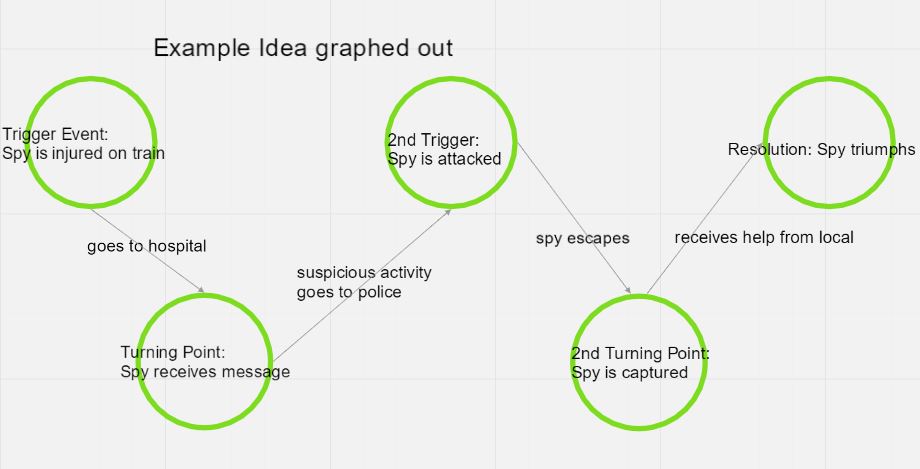
For Wild Waters I’m writing in two different time periods – WWII and Vietnam ­– and they each use distinctive slang that I organize in a couple of basic lists.  There are also multiple character points of view and it is important to keep track of what characters know and when they know it, so that each plot point is revealed at the correct time. Tracking character arcs are more difficult and sometimes require multiple ways of visualizing.  I will frequently write out the plot from each characters point of view or I will graph it out on a virtual whiteboard, utilizing the main plot points.


There is no perfect system of course, and each author must work the way that works for them. But when examining a well-written book, I am frequently in awe, not just of the beautifully constructed words or strong turn of phrase, but the underlying construction of a book.  Sometimes, I find it amazing that any books get written at all.

***
Bethany Maines is the author of the Carrie Mae Mysteries, Tales from the City of Destiny and An Unseen Current.  You can also view the Carrie Mae youtube video or catch up with her on Twitter and Facebook.

Friday, March 4, 2016

Taking Editorial Feedback Professionally

by Linda Rodriguez

At the end of a course I recently taught, one of my students sent me a scene-by-scene outline of her book. I could see as I considered it where her problem lay—and it was a pretty major problem. I had to consider whether to soft-pedal my response. This student had been very open about how discouraged she was, and I certainly didn’t want to discourage her any more than she already was. Still, I gave her my best detailed critique of what her book’s problems were and what she could do about them. Then, I took a deep breath and tried not to think about it.

I stopped doing developmental editing for quite a while after a run of several clients who didn’t really want truthful, constructive criticism, even though they were paying for it. When I did return to developmental editing (at the request of a couple of students), I wrote a one-page information sheet that I give to all prospective clients. It explains what developmental editing is, what it is not, discusses the cost and details of what it entails, and ends with this paragraph.

“This kind of editing entails clarity and honesty about the manuscript’s strengths and weaknesses and how to improve it, always keeping in mind the writer’s original vision. It is not for writers who have problems with criticism of their work or who are seeking an ego boost. For such writers, developmental editing is a waste of their money and of my time.”

One of my current clients laughed when she read it and said, “It sounds like you’re trying to drive away business, not attract it.”

I nodded. “I am. If someone’s not serious and professional, I don’t want to deal with them.”

My recent student came through like a champ, though. She emailed a long thank-you for the critique, saying no one could or would ever tell her what wasn’t working in her book. She’s now all enthusiastic about doing the necessary work to make her book good. And I was grateful and relieved to read that she has such a professional attitude.

Aspiring writers sometimes forget that, even when they have publishing contracts, they will have editors who will point out ways in which their books could be stronger. If they’re lucky, their agents will already have done some of that. It’s a natural part of the publishing process. Almost every change my editor ever wanted me to make worked to create a better, more powerful book. Part of being a professional writer is being able to make good use of professional editing critiques from teachers, developmental editors, agents, and publishing house editors.


What are your feelings about editorial feedback? Are you one of those writers who see the editor as a natural enemy? Or are you one, like me, who sees the editor as the person who’s trying to keep you from looking bad in public?

Linda Rodriguez’s three novels published by St. Martin’s Press featuring Cherokee campus police chief, Skeet Bannion—Every Hidden Fear, Every Broken Trust, and Every Last Secret—have received critical recognition and awards, such as Latina Book Club Best Book of 2014, the Malice Domestic Best First Traditional Mystery Novel Award, selections of Las Comadres National Latino Book Club, 2nd Place in the International Latino Book Awards, finalist for the Premio Aztlán Award, 2014 ArtsKC Fund Inspiration Award, and Barnes & Noble mystery pick. Her short story, “The Good Neighbor,” published in the anthology, Kansas City Noir, has been optioned for film.

For her books of poetry, Skin Hunger (Scapegoat Press) and Heart’s Migration (Tia Chucha Press), Rodriguez received numerous awards and fellowships. Rodriguez is 2015 chair of the AWP Indigenous/Aboriginal American Writer’s Caucus, past president of the Border Crimes chapter of Sisters in Crime, a founding board member of Latino Writers Collective and The Writers Place, and a member of International Thriller Writers, Wordcraft Circle of Native American Writers and Storytellers, and Kansas City Cherokee Community. Find her at http://lindarodriguezwrites.blogspot.com.

Wednesday, June 10, 2015

That Editing... So Hot Right Now


by Bethany Maines

It's that time again. The editing time.  The time when I get back all the stupidy stupidy line edits and have to go through and approve them. That's the worst part.  I have to approve them.  OK, I don't absolutely HAVE to, but the truth is about 8 out of every 10 line edits are the correct decision. Of the other two, one is probably a matter of preference and the other is absolutely right the way it was the first time. Why don't you understand my genius you piddling moron who is merely paid to sift through the words and divine my sheer awesomeness?

It's possible that the last sentence there was a bit of an overstatement.

But my secret internal Mugatu doesn't think it was.


Mugatu, for those who haven't watched the hilariously improbable Zoolander, is the fashion designer / evil genius, played by Will Ferrell, who is attempting kill the prime minister of Malaysia by brainwashing male model Derek Zoolander. Many writers, myself included, seem to yo-yo between the states of modesty (I write pretty well), ego (I'm a genius!!), and self-hatred (why would anyone read the crap I produce?). I picture modesty as the quiet saintly type – a Buddhist nun (who secretly knows kung fu) and self-hatred as the goggly-eyed guy from the Maltese Falcon who says the worst things in the sweetest voice.  And nowhere are those states of being more quickly cycled through than the editing rounds. Each tweak of the text from the editor is like some sort of judgement from on high that can send me off into a Mugatu-esque rage or goggly-eyed shame spiral.  It's up the the Kung Fu nun to bring balance and harmony. Although, admittedly sometimes the nun needs a little help from a glass of wine and a jog around the block.


Bethany Maines is the author of the Carrie Mae Mysteries, Tales from the City of Destiny and An Unseen Current.  You can also view the Carrie Mae youtube video or catch up with her on Twitter and Facebook.

Wednesday, October 23, 2013

Narwahl!!

by Bethany Maines


It seems like I’ve been thinking more about structure and organization lately.  From trying to tame my husbands hoarder tendencies, to how to enhance the drama in a novel, everywhere I look it feels like everything needs more structure. 

To solve my husband’s “issue” I’ve decided that some of his things need to go live out in the carport.  Which is a bit like telling a writer that some of their favorite parts need to get axed from a manuscript.  First, you lead them along the path of logic and hope that they decide for themselves that something has to go, and then eventually you just blurt it out – “That doesn’t fit.”  In my husband’s case, I mean, quite literally, we cannot fit anymore in the spare bedroom.  In the case of a manuscript it’s more like, “This doesn’t sound anything like the rest of your book and it’s a bit of a tangent from the plot.  Do you really need it?” 

But some things do belong in the house.  It’s just that being buried in the closet doesn’t exactly display them to their best advantage.  I’ve got this pretty well figured out in my house.  I know what I like and I have a pretty good idea of what would be useful to us.  (Hint: it’s bookcases, MORE bookcases.) But in a book, it’s a little more difficult. Do I need this part about the narwhal?  (Hint: Yes, when it comes to narwahl’s the answer is always yes.)  Ok, so I need the narwhal, but would it look better over here?  Or maybe it would look better if I removed this part about the teakettle that’s sitting next to it?  What makes for the biggest dramatic reveal of a narwhal?  This is where editors, beta readers, and interior decorators come in extremely handy.  With an educated eye they can tell you what will create a focal point and what you should blur over.

But I suppose an “educated eye” is the key phrase there.  Five years ago, I couldn’t tell you with any certainty, what belonged in a book and what was something I just happened to like.  The more I read, the more clarity I get on what creates dramatic continuity and what pieces, while possibly beautiful, funny, or perfect in their own right, don’t belong in the manuscript.  Each book is it’s own learning process, but each book does teach me something.  Hopefully, by the time I’m oh… say 95, I’ll have this whole writing thing figured out.


Bethany Maines is the author of the Carrie Mae Mystery series and Tales from the City of Destiny. You can also view the Carrie Mae youtube video or catch up with her on Twitter and Facebook.


Wednesday, September 25, 2013

How to Cut?

by Bethany Maines


On my first novel, Bulletproof Mascara, my agent strongly recommended removing a few chunks of the manuscript that she considered extraneous to just about everything. This was a complete misperception. Those chunks of writing were vitally, vitally important to the entire fabric of book. Although, to be honest, I now don’t remember what those vital chunks were, and the book is undoubtedly better off without them. At the time, however, the advice was very difficult to hear and I resisted it mightily. I also remember that as she recommended painfully amputating these important bits she would say, soothingly, sadly, sympathetically, “I know, but maybe you can use them in something else.”

I puzzled over that phrase after I hung up the phone. Something else? What could she have possibly meant? Maybe she meant that I could use that scene in a sequel? But the situations were kind of specific – they couldn’t just be transplanted. And having snipped them out and written over them, they couldn’t be flashbacks. Maybe she meant that they could be used in another story – transplant different characters into those scenes. Now, that was a completely ridiculous suggestion. Those events happened to those people. You can’t just go plopping whole new people into those events. Which, frankly, is just proof that writer’s are one step away from having diagnosable mental health disorders featuring false realities and voices of people who aren’t really there.

Eventually, I decided that what she really meant was, “However, you have to wrap your mind around this to make it ok – do it, because it’s for the greater good of the book.” Of course, the idea that someone else might have a better grasp on what my story and book should be is also a hard thing for a writer to wrap their mind around. Eventually, I did come to peace with both concepts, but I find that as I help other writers through the editing process, that I still don’t know what to tell them when I advise cutting out favorite scenes. Should I suggest that they can “use them in something else” or do I just give it to them straight – your book is better off without this scene (even though you love it and sweated over it)? For all of you writers out there, what has helped you come to terms with cutting out beloved moments?


Bethany Maines is the author of the Carrie Mae Mystery series and Tales from the City of Destiny. You can also view the Carrie Mae youtube video or catch up with her on Twitter.

Wednesday, March 13, 2013

Truth or Typos

by Bethany Maines

Last night, I had a dream about a “friend” I haven’t seen in about five years.  My dream revolved around the fact that my old friend had published a book and she was showing it to me in (what some might consider) a really snotty way.  Never mind that in real life she never had any interest in writing and that this scenario is entirely unlikely. It was a dream, so we’re just going to go with it, ok?  Anyway, I opened the book and saw that the entire preface was entirely covered in typos. I immediately wanted to hand her the business cards of every editor I’ve ever met, but my family told me that the book was published now and that there wasn’t much point and it would only offend her. Basically, they told me to keep my mouth shut. This annoyed me so much that I woke myself up.

There was quite a bit of tossing and turning as I tried to get back to sleep.  Not only was I annoyed about the typos, but thinking of this “friend” annoys me. I put “friend” in quotes, because I think, at this point, we can safely say that this particular woman and I are no longer friends.

Like any adult, I have a few friends that got lost along the way, but, in general, I haven’t gotten rid of many people. For one thing, making friends is hard, and I’m lazy – I’d really prefer not to go through that effort again. But also, the friends I do keep around are, what I suppose my grandmother would call, “true blue.” These girls know where the bodies are buried, where the bridal shower photos are hidden, and all the words to Summer Nights from Grease. Also, for reasons too complex to go into, we can do an amazing rendition of Love Shack from the B-52’s. You don’t just memorize Love Shack on a whim, so losing a member of the band is difficult.  

Or at least it should have been. But the last conversation my ex-friend and I had was when she called to announce that she was pregnant and I said, “Great, I’ve been meaning to tell you that I’m getting married next month.” Clearly, we’d drifted apart. Our steadily widening continental divide was fairly predictable, not entirely her fault, and kind of my choice (I stopped calling her and she never noticed), so why does it still bug me when she turns up in a dream? Am I mad at her failure as a friend or mine?  Or am I just annoyed by the typos?


Bethany Maines is the author of Bulletproof Mascara, Compact With the Devil and Supporting the Girls, as well as The Dragon Incident, the first short in her new series Tales from the City of Destiny. You can also view the Carrie Mae youtube video or catch up with her at www.bethanymaines.com.  

Wednesday, November 9, 2011

Writing is Like Getting Punched in the Face

or
Your Sensei-ism of the Day

by Bethany Maines


A member of my writer’s group, who is at the relative beginning of her writing journey, recently turned in a story for critique and my response was that clearly the middle sucked and it needed to be totally restructured, but other than that the story was great. Or at least, that’s probably what I sounded like to her. She understood that I wasn’t trying to be mean, but, as another member of our group pointed out, she probably hadn’t been expecting a critique of that magnitude, and was probably more hoping for a stamp of approval, with maybe a “just change a few lines here or there.”  And then I had a sharp memory that I used to feel the same way (and occasionally I still do).

One of the other things I study, besides writing, is karate. Now, the first thing everyone asks is, “What belt are you?”  So let’s just get this out of the way now. I’m a third degree black belt. Most people have no idea what that means, but it sounds impressive, so they give enthusiastic nods. (Or if you’re that dillhole trying to date a black belt, you make an ineffectual grab and say, “What would you do if I did this?”  Um…. Throw you on the floor and then watch how you never call again?  Right, that’s what I thought.)  There are many belts between white (absolute beginner) and black, and each one is an achievement that is worthy of being bragged about. Sadly for poor karate students talking to random acquaintances, if it ain’t black, it ain’t nothin’.  So if you know a karate student and they say “green,” congratulate them on their hard work and, unless they’re six, please don’t ask them to show you anything. If they’re six, then ask away, because that’s just plain adorable. But, word to the wise, if you’re a dude protect your crotch (unless you’ve got the video camera rolling and want to win $10,000 on America’s Funniest Home Videos), because we all know how coordinated your average six year old is.

Anyway, back to the point (why does everyone always doubt I have one?). I’ve been a sensei (teacher) for long enough that I’ve started to see trends or traits in the course of a karate student’s journey. One of the most common beginner traits is that once a student has learned a technique, say reverse punch, they consider it complete. Why would we revisit the topic? And then I have to break it to them that I’ve been learning my reverse punch for about eleven years now. And I’ll learn some more about it tonight when I go into the dojo. Each time I cross the threshold and bow to the dojo, whether or not I’m teaching the class, I’m there to learn.

But when you’re a white belt, you’d really just like to get your reverse punch signed off so you can test for the next belt. Being told to go back and do it again can be very disheartening, but from the black belt perspective it can also be very freeing. I’m free to get the first one wrong (and the third, and the fifth, and the twenty-fifth) because I’m going to do it again.  With karate, and with writing, there is always the opportunity to go back the next day and do it again.

I know that when I started writing, I didn’t want to edit.  And then I rewrote my first novel 9.5 times.  And believe me, I wanted to stop at about 6.  But after awhile, I started to think that a novel is a fluid thing with endless permutations of how it can be put together. I can’t be hamstrung by the idea that the first draft has to be the finished draft; by accepting that I’m going to be wrong I free myself to create something better.

They say there are very few masters in karate, but many students – meaning that, while some may be more advanced, we are all still learning.  I believe the same can be said of writing. 

Tuesday, July 26, 2011

Get out your dancing shoes

by: Joelle Charbonneau

Let the trumpets and cymbals sound. Tell the band to strike up a tune because we are having a party. I am celebrating the completion of my new novel. Hurray! And at the end of this post I plan on giving something away to complete the celebration. So stay tuned.

Writing this manuscript was a great deal of fun and now comes the real work – editing it. There are a lot of schools of thought on how and when you should edit. And since I tend to like to try new things will admit that I’ve probably tried them all.

There are a lot of writers who actually edit as they write their first draft. Susan Elizabeth Philips is one who edits what she wrote the previous day before getting down to writing new pages. That way the story gets cleaned up and the characters are fresh in her head when she gets down to business. It might take longer to get the manuscript written, but hey – it is ready to go out the door when you’re done. This one has never worked for me, but Susan’s writing rocks. Which clearly means I am doing something wrong.

A lot of people say that once a book is finished you should stick it in a drawer for a couple of weeks so you have enough distance that you can look at your work with a fresh eye. This was one of those things my high school English teachers always told me to do. And hey – it sounded great, but during my high school years I worked best under pressure. As in midnight before the paper is due at 8AM kind of pressure. (And yes for all my college friends – I confess. I did this in college, too.) Fresh eyes? HA! I was happy to settle for slightly reddened eyes. But while I didn’t use this much in my early years, I feel it has huge merit and I’ve used it more than once to what I hope was great success. Distance between you and your writing means you’ll actually see what is written on the page instead of what you intended to write.


Which brings me to method number three. This won’t come as a surprise to my family or my friends, but I am kind of the impatient sort. If there is work to be done, I want to do it NOW! Which is why I ask (beg, bribe, threaten) my fabulous beta reader and wonderful husband to read along as I write. (Yes, our marriage survives this, which is a testament to his patience or my cooking – you can decide which.) He makes notes on the manuscript which gives me a starting point when I go back and start revising. Which tends to be the day after I finish the book. And yes – you guessed it. I have already started revising my current manuscript. I can’t help myself.

Which way is best? You tell me. Is there one editing plan that works better for you than another? Did you revise one way in high school and change your style in college? I really want to know.

And for all of you still reading this post – I have an extra ARC copy of SKATING OVER THE LINE (Sept. 27, St. Martin’s Minotaur) that I am going to give away to one commenter today! Please leave your name and e-mail address in the comments line so I can get a hold of the winner. I’ll do the drawing after midnight so get your comments in before then.

Thanks for celebrating with me.

Friday, August 28, 2009

Atkins Editing: Thick Meat, No Bread

Rachel Brady is celebrating the release of Final Approach this week with five days of freebies at her blog. Click through to Write It Anyway and enter to win your choice of prizes. Today’s the last day!


Lately I’ve been thinking about revisions, but more on that shortly. First I’d like to thank the Stiletto ladies for inviting me back. I feel like a lucky freshman invited to sit with the cool seniors in the school cafeteria. Our lunch conversation today has to do with how editorial comments are like food. Slide up your tray and have a seat.

Not long ago I found a post about critiques in which the sandwich technique was explained. The suggestion was to structure a critique the way you’d build a sandwich—in this case, with constructive criticism sandwiched between two positives.

For example: “I like the story idea, but your characters could be fleshed out more. Nice use of dialogue, though.”

Or maybe: “Nice hook. You might consider condensing the restaurant scene . . . it ran on a bit long. But I liked that paranoid waiter.”

You get the idea.

I favor this approach and promise everyone reading this that I will remember and apply it forever, now that I have experienced Atkins Editing.

Earlier this month, my editor looked over the early pages of Book 2 and served up an enormous, Dagwood style, meaty sandwich. Turkey! Ham! Pastrami! Salami! (For purposes of my story, let’s pretend these are bad things.) Only problem with the sandwich? No bread.

My first reaction was to eat cookies but finding none in my house, I self-medicated on pretzels instead. Calorically speaking, this was lucky. Where editorial feedback is concerned, I later decided, cookies should be treated like handguns. Let’s put a 24-hour waiting period between revision comments and cookies. At least in my house.

Enter irony.

The same day I got the pages back, an interview I’d done for Novel Journey ran. Upon learning of my writerly depression, my friend Cathy was quick to send back a quote from my own interview. She’s sassy that way:

NJ: What is your best advice on maintaining a good editor-author relationship?

Me: Trust your editor. Accept that writing and editing are different skills. A talented editor can make your work shine if you’re willing to step back and seriously consider her suggestions. You both want the same thing: the best story possible.
I read the words and wondered who in her right mind would say something thing like that. But that was the problem. I wasn’t in my right mind again yet. The high protein, zero carb non-sandwich was still too deli fresh for me to think straight.

There is a happy ending.

The next day I received an e-mail from my editor explaining that she’d jotted her notes on the manuscript hastily before leaving town, intending to use them as reminders to herself later when she wrote my revision letter. The marked manuscript went into the office mail before she elaborated on her notes. This misfortune resulted in my unwrapping all that ham.

Her letter was very reassuring, altogether kind, and gave me the same warm feeling as joining Maggie, the Evelyns, Marilyn, and Susan at the cool table. There was a sandwich afterall. It started with, “While there is much to like I am uneasy on several counts.” Bread.

It helped to understand her intentions: “This second novel is always the hardest to write, and by far the hardest to sell. Everyone cuts the author a break with a first novel and comes out with knives sharpened for the second. You don't want to give anyone grounds for disappointment or carving up the book.”

My favorite was, “I hope you don't think I'm negative about your work, I like it. I’m trying to help you dodge the critical traps that beset most authors.” Bread with mayo—technical advice coupled with mentorship and foresight.

There are lessons here.

Trust your editor. Embrace carbs. Bon appétit.

Rachel Brady

Thursday, March 20, 2008

After "The End"

"The End."

The sense of euphoria lasted about 24 hours after the Northern half of Evelyn David typed those magic words. She claimed it was her turn since I'd typed them for Murder Off the Books.

What my family and friends all refer to as "The Book" is done. Our manuscript for Murder Takes the Cake is finished!

Hurrah!

Now it's time for the nitty-gritty part of writing—self editing and formatting the manuscript.

Yea! Not!

We're in a dash to slash passive verbs, count the dots in ellipses, and conduct a head count of all our plot bunnies. We need to objectively examine each scene and decide if it's necessary. Does it add to the plot; provide an important clue or red herring; give depth to a character? Or, as we sometimes discover, is a scene just useless padding, words that increase the page count without offering any other added value.

We also need to prepare the manuscript in the right format. That means literally going through every sentence to be sure that we have doubled-spaced after each period, question mark, and exclamation point. Why not just use the search and replace function? Because sometimes a sentence is enclosed within quotation marks, so a double space after a period doesn't belong. As the Northern half often says, Oy!

This is not the fun part for me. This is like cleaning the kitchen after cooking and enjoying an elaborate feast. It has to be done, but it's not fun.

Both halves of Evelyn David have reread "The Book" from start to finish at least four times over the past couple of days. The Northern half's husband was the first to read the full draft. He gave it a thumbs-up and advised us on our hard liquor choices for the book. We needed an expensive malt whiskey for our plot. I didn't have a clue. Me? I'm a connoisseur of wine coolers. Smirnoff's Green Apple Bite is my alcoholic beverage of choice. For some reason I haven't been able to envision a scene where "Mac Sullivan," a retired D.C. police detective orders a Green Apple Bite.

We'll read "The Book" a dozen times more before we show it to a couple of eagle-eyed friends for proof-reading. Tonight, I'm hoping to get through about 5 chapters before giving my eyes a rest from the computer screen, then I'll pass the book (electronically) back to the New York half. We'll continue to work off of one copy now that we're in the home stretch.

As I told a group at the Will Rogers Public Library in Claremore, Oklahoma on Monday night, writing a book is like riding a bicycle. By the time you're coasting down the hill, enjoying two full minutes of the wind blowing your hair and reveling in your well-deserved sense of accomplishment, you forget the long days of pedaling up the slope. You forget the excruciating leg cramps, the painful blisters, the heat of the sun beating down on your head, the sharp rocks in your shoes, the multiple flat tires, and …. Well you get the idea.

Anyone for a bike ride?

Evelyn David

Friday, February 29, 2008

Deleted Scenes

Award-winning investigative reporter--and now Agatha nominee--Hank Phillippi Ryan is currently on the air at Boston's NBC affiliate, where she's broken big stories for the past 22 years. Along with her 24 EMMYs, Hank’s won dozens of other journalism honors. She's been a legislative aide in the United States Senate (working on the Freedom of Information Act) and worked at Rolling Stone Magazine with Hunter S. Thompson. Her first mysteries, Prime Time and Face Time, were best sellers. Air Time and Drive Time are coming soon from MIRA. And this just in: Prime Time is an AGATHA nominee for Best First Mystery.

Thirty (or so) years ago, when I was just starting as a TV reporter, my first news director (think Lou Grant) gave me some advice that baffled me at the time. He said, “The hardest part about writing a news story is deciding what to leave out.”

I was such a newbie, I thought the hardest part about writing a news story was—well, everything. But as I began to learn my craft, I realized he was right. You don’t have to “empty your notebook” into your story. You don’t have to tell everything you know.

And now, writing mysteries, isn’t it the same?

When I finished the first draft of Prime Time, I joyfully took the floppy disk with my dear first novel on it to the Kinko’s down the block from Channel 7. “Could you print this for me?” I asked. I lowered my eyes, then looked modestly back up at the copy kid. “It’s my novel.”

“Sure, lady,” he said. Not that impressed. But I was—exultant—that soon I would soon see my very first manuscript printed out on actual paper.

Two hours later, I returned as instructed. This time the kid said, “Oh, you’re the one with the novel.” “Yes,” I replied, fluttering my eyelashes, wondering if maybe he had a sister or mom who would eventually love it.

He bent down under the counter, and pulled out a ream box of paper. “Oh, thanks,” I said, and turned toward the cash register.

“Hang on,” he replied. He leaned back down under the counter, and pulled out another ream box of paper. “Here’s the rest of it,” he said, placing it on the counter. “Guess your book’s pretty long.”

I had neglected to number the pages. But, turned out, it was 723. Seven hundred and twenty three pages.

And that meant Four. Hundred. Pages. Had to go.

Which brings us back to my news director. He was right again. I had to decide which of my precious words to leave out. More on that in a minute.

Last night, my husband and I watched a pretty good movie on DVD. When it was over, I clicked to the deleted scenes. “Why do you always want to watch the deleted scenes?” Jonathan asked. “They’re deleted.”

But you know why. Those deleted scenes—and the reasons the director gives for cutting them—are a little private seminar-on-the-couch on how to decide what to leave out. It works for movies, it works for our mysteries.

For instance. One scene by itself was perfectly good. But the director explained it had to be cut because it would slow the action.

In my head, I rewound, and played that part of the movie back including the deleted scene. He was right. It would have dragged.

He moved on to another very well-acted scene, where two characters slowly learned more about each other. I don’t think I imagined the regret I heard in his voice, as he described how tough it was to inform the actors that this emotional and well-shot scene was going to hit the cutting room floor. But, his analysis showed, nothing was really learned. The plot wasn’t advanced. Sorry, guys. Cut.

Finally, he showed a scene near the end. It took place in a living room, where a phone call brought good news that a missing father was coming home, and the viewer saw that his son had been born in his absence. It was sweet and touching.

Nope. It pulled the punch, the director said. How much better, he explained, to pick up the action with the father arriving home. To have the viewer see the baby—for the first time—at the same time the father did. Yes, of course. Much better.

Deleted scenes. The director loved them when he shot them. But—even more-- he loved what was left without them.

Of course, part of the difficulty with cutting is fear. Fear you’re going to ruin something. Fear you’ll never be able to put together words so nicely again. Fear you’ll cut the wrong thing.

But you’re the director in your mystery, right? You yell ‘action!’ every time you begin to write. And the characters (sometimes) do what you say. Part of the fun of cutting is seeing the sleek, fast-paced page-turner that emerges--as you begin to compile your own reel of deleted scenes.

It’s your power. Your strength. Decide which words to leave out. Do it. You’ll never miss them.

Hank Phillippi Ryan
http://www.hankphillippiryan.com/