Showing posts with label organizing. Show all posts

Monday, February 3, 2020

The Big Planner Shake-Up


By Debra Sennefelder

What happened at the beginning of January was an unprecedented shake-up in how I plan my life. And it all started in the latter part of 2019.

There was a post on Facebook. A fellow author was looking for suggestions for planners. Like us all, she was looking to get a head start on organizing 2020. I commented that I’d been using an Erin Condren Life Planner for two years, but I intended to go back to my six-ring A5 DayRunner.

After careful consideration, I decided to go back to the A5 because I wanted the flexibility of being able to organize the planner how I wanted it. And I wanted more space to write my to-do tasks for each day.

With the decision made, I ordered new inserts for the A5. As soon as the inserts arrived I began noting all my deadlines, birthdays, appointments, etc. Everything was good.

So, I thought.

Something started not to feel right with the A5. My first thought was maybe it was due to the texture of the binder. For some it may not be a big deal, but since I handle my planner multiple times during the day, how it feels in my hands is essential to me. I then thought maybe I was over the black cover. Perhaps a pop of color would be nicer and more visually appealing. The temptation to buy a new A5 was strong, but I held strong. The DayRunner was good enough.

So, I thought.

In early January, I signed up for a free online workshop on how to go paperless. During the class, I learned some tricks on how to go partially paperless (some papers just can’t be scanned and shredded). One of the recommendations was a to-do list app. This was new to me and I decided to give it a try.


With the app downloaded to my phone, I began using it. After a week, I realized the app wouldn’t work for me because once a task was completed, it was deleted from the list. I’m one of those people who need to cross off tasks from a list and be able to see what I’ve accomplished at the end of the day. While the app didn’t work for me, it did introduce me to using my phone as a part of my planning process. Which led me to my Google calendar. Yet again.

I’d tried using the Google calendar before, and it never clicked. Until now.

I planned out the whole month of January. Color-coding the tasks was a nice perk. And I got into the habit of opening up the calendar in the morning right after my morning pages were completed. What I’d been craving in my “planner” was the ability to look at the monthly spread without having to page back and forth all the time in the A5 or EC. Sure, I could have a wall calendar, but then I have to take it down and write in the task, then put it back up, and for me, it becomes visual clutter on the wall. The Google calendar was working for me. Finally.

But there was still a piece of the puzzle missing. While the Google calendar gave me a view of the month, I was missing the daily planning. All the things I need to do from laundry to outlining to walking Connie. Yes, I know there’s a daily view feature in the Google calendar, but I prefer to write these lists down so I can cross of all the completed tasks.

I gave some thought, and I ordered a new planner from Amazon. It’s bigger than a personal size Filofax but smaller than an A5, and it has a page for every day. This gives me plenty of space to write my lists, group my to-do actions into categories if I want to, jot down ideas that pop into my head. Since I don’t use the monthly spread for planning, I use it to track my workouts. It’s awesome.

Finally, between the Google calendar and my new daily planner, I have the perfect planning system for 2020. I know this because I feel calmer when it comes to my to-do’s, and I’m getting things done without feeling scattered or overwhelmed.

Most of the time, a shake-up can be a negative experience, but this time it was a gift. I trusted myself enough to let go of what I’ve clung to for years, and it’s been one of the best things I’ve done so far in 2020.

I’m curious. Do you use a physical planner? A digital planner? Or, a hybrid like me?


Debra Sennefelder is the author of the Food Blogger Mystery series and the Resale Boutique Mystery series. She lives and writes in Connecticut. When she’s not writing, she enjoys baking, exercising and taking long walks with her Shih-Tzu, Connie. You can keep in touch with Debra through her website, on Facebook and Instagram.

Tuesday, April 19, 2016

Winging It

by J.M. Phillippe

Earlier this month, fellow Stiletto Gang author Bethany Maines posted a great blog about how she organizes her novels using spreadsheets and graphs -- all online! I was super impressed. And then intimidated. Because my organization of a novel looks a lot more like this:

Images of writing notebooks
Sometimes I can't even read my own writing.
 I don't even remember to put all my notes about the same story in the same notebook.

I do start out trying to be super organized. I spend a lot of time procrastinating...er...pre-writing by creating elaborate systems and files that some part of me knows I will never maintain. I understand that that the more up-front work I do, the less back-end work I'll have to do. And yet, inevitably, at some point during a writing project I find myself digging through various notebooks and poorly named Word files, trying to find that one piece of information I need to complete whatever section I'm working on. I have to scan first drafts specifically for continuity errors (like the spelling of a name), and if it wasn't for eagle-eyed readers and editors, I'd miss small changes I made in even basic descriptions (did that room have a brown leather chair or a burgundy leather chair?).

Vader is not impressed with me.
I also only ever make it half-way through a novel outline before the drafting process takes over, and characters and plots move in totally different directions. It's a little bit because I find outlines kind of boring, and a little bit more that if I get too detailed and figure out how it will all end, I lose interest. Generally, I never start with more than a vague sense of where I want to end up, and I find drafting it out so much more satisfying. And yet I know that an outline would probably make the entire process a lot less messy -- and faster -- if maybe not as spontaneous.

Of course, come revision time, I then I have to backtrack and do all the work that I maybe shoulda coulda woulda done in the pre-writing process. I create a reverse outline of my chapters and sections. I make a style sheet and finally decide on a single spelling of a name (the search and replace feature in Word is very much my friend). Changes are always intentionally planned. I invest heavily in the revision process, and the story can change dramatically from draft to draft.

In many ways, starting off by winging it and then going back and organizing what I've written lets me discover the story in two different ways -- as I write it, and after I go back and read what I've written. That process of discovery keeps me interested in the story, even if it is very labor intensive.

Still, I can't help but look at the ways other writers organize themselves and wistfully daydream about my own set of spread sheets and graphs. Sometimes though, I'd settle for remembering exactly where I put that really great breakdown of the third act I thought of while on the bus two months ago. All I have to do is figure out what notebook I had with me that day...


***


J.M. Phillippe is the author of Perfect Likeness. She has lived in the deserts of California, the suburbs of Seattle, and the mad rush of New York City.  She worked as a freelance journalist before earning a masters’ in social work.  She works as a family therapist in Brooklyn, New York and spends her free-time decorating her tiny apartment to her cat Oscar Wilde’s liking, drinking cider at her favorite British-style pub, and training to be the next Karate Kid, one wax-on at a time.


Wednesday, April 13, 2016

Organizing My World(s)

by Bethany Maines

An author’s job is not just to tell a story, but to decide how a story should be told. Is it better in first or third person? Is it told in one long march of words or are their chapters? We have to decide genre, tone and feeling. And once those decisions have been made an author must create and track the main plot of the story - the one that we struggle to capture in the blurb text on the back cover – as well as the sub-plots, underlying themes, and finally, the characters themselves.  All of those pieces require not just the ability to write, but also the ability to track information. Because, as any serious reader will tell you (sometimes at great length), consistency and details matter greatly to a well written book, and while we can rely on an editor for some items, they are only human and can only catch so much.  It is in an author’s best interest to provide the cleanest manuscript possible.

I’m currently working on two vastly different stories: the fourth Carrie Mae Mystery Glossed Cause and a Romance Horror novella Wild Waters.  Each story comes with an array of characters, research and plot twists that to be perfectly honest I can’t hold in my brain.  Possibly pre-production of a toddler I could have kept hold of all the details, but no longer. Now, to keep all my worlds organized, I must rely on a system of notes, plot outlines and spreadsheets.


For the Carrie Mae books I track characters with a spread sheet that notes who they are (name, basic role, job or company) and also what book they have appeared in or if they have been deleted or omitted from a book.  I also have a rather extensive style sheet that helps me keep track of how certain things, such as chapter headings are formatted and whether or not I’m consistently formatting things like “AK-47” and “INTERPOL” the same way over multiple books.

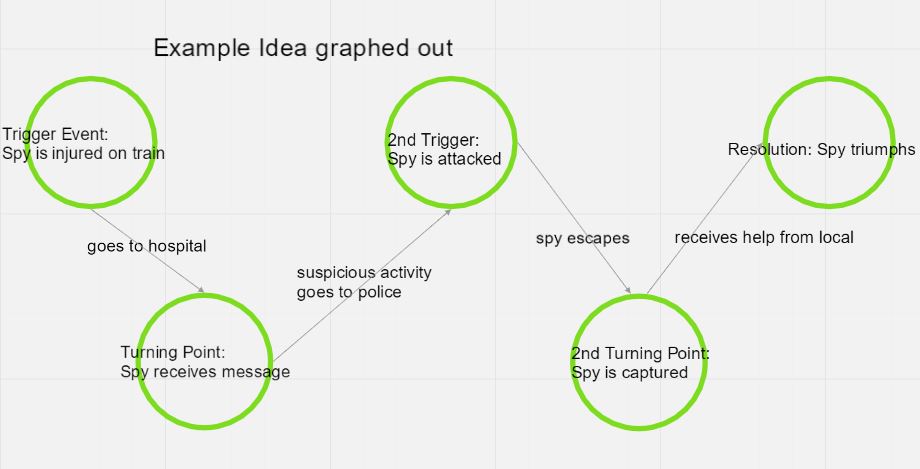
For Wild Waters I’m writing in two different time periods – WWII and Vietnam ­– and they each use distinctive slang that I organize in a couple of basic lists.  There are also multiple character points of view and it is important to keep track of what characters know and when they know it, so that each plot point is revealed at the correct time. Tracking character arcs are more difficult and sometimes require multiple ways of visualizing.  I will frequently write out the plot from each characters point of view or I will graph it out on a virtual whiteboard, utilizing the main plot points.


There is no perfect system of course, and each author must work the way that works for them. But when examining a well-written book, I am frequently in awe, not just of the beautifully constructed words or strong turn of phrase, but the underlying construction of a book.  Sometimes, I find it amazing that any books get written at all.

***
Bethany Maines is the author of the Carrie Mae Mysteries, Tales from the City of Destiny and An Unseen Current.  You can also view the Carrie Mae youtube video or catch up with her on Twitter and Facebook.