Monday, June 1, 2015

Dressed to Kill -Releases June 23rd

Hey Gang,

Dressed to Kill - sounds like a book someone on the Stiletto Gang would write, doesn't it? Dressed to Kill is book #4 of The Tourist Trap mysteries with my amateur sleuth-slash-coffeehouse-bookstore owner, Jill Gardner.

I adore fashion, but like Jill, you're more likely to see me in a pair of cotton capris and a tank top, especially in the summer. I've given up the fight to be fashion forward, now, comfort is higher on my priority list, especially since I spend a lot of time in front of the computer, sitting. And my bottom is beginning to mold to the shape of my office chair.

So when Jill finally meets her new boyfriend's ex-wife, she's shocked at how much Sherry looks like she's running for Miss California rather than just running a small town clothing store. The girl knows her fashion, and she's not afraid to use it. Or wear it, even when South Cove is more California casual.

Which puts my yoga pants (which I LOVE) to shame.

So what about you? Are you comfortable in heels and pearls? Or would you rather be in flip flops and a cute charm necklace?

I think you know where I stand already. :)

Lynn

BTW - if you like your books in paper format, you're in luck. Dressed to Kill is already available for your reading pleasure. But the Kindle version releases on June 23rd.

Dressed to Kill

Jill Gardner—owner of Coffee, Books, and More in the tucked-away town of South Cove, California—is not particularly thrilled to be portraying a twenties flapper for the dinner theater murder mystery. Though it is for charity…

Of course everyone is expecting a “dead” body at the dress rehearsal…but this one isn’t acting! It turns out the main suspect is the late actor’s conniving girlfriend Sherry…who also happens to be the ex-wife of Jill’s main squeeze. Sherry is definitely a master manipulator…but is she a killer? Jill may discover the truth only when the curtain comes up on the final act…and by then, it may be far too late.

Wednesday, May 27, 2015

Ask the Conductor

By Bethany Maines

Recently, I spent an hour at our historical documents library chasing down the names of the trolley stops between Tacoma and Spanaway Lake in the year 1914. Why, I hear you ask? What possible strange writer thing could I be up to? Is there a new novel in the works featuring a motorman’s adventures trying to the clear the name of a fellow conductor whose trolley appeared to take a turn too fast and go over an embankment fiery ball of flames in turn of the century Tacoma Washington? No, although now that you mention it, I would totally read that novel.


In fact this research mission was related to my day job – graphic design. While it’s rare for a design job to take me to the library, I strongly feel that both hats that I wear revolve around the same theme – I tell stories. Sometimes it’s in words and the stories are of my own in invention and sometimes it’s for a client who wants to showcase their unique narrative either in print or in the case of the trolley client on the side of their building. Yes, they take different skills, but at the end of the day, I feel like there’s a lot of overlap. Each project must have a beginning that sets the stage and leads the viewer/reader into main message and then conclude in a satisfactory manner. I think my ability to spot a narrative aids me in both lines of work. And of course, the benefit to being paid to research strange topics, is that who knows when a novel will require the use of my new found trolley knowledge.


Bethany Maines is the author of the Carrie Mae Mysteries, Tales from the City of Destiny and An Unseen Current.  You can also view the Carrie Mae youtube video or catch up with her on Twitter and Facebook.

Friday, May 22, 2015

Do Mystery Writers See the World in a Different Way??????

Do Mystery Writers See the World in a Different Way?? 
by Debra H. Goldstein

Do you think mystery writers see the world in a different way? My husband, children and friends do.

For the past few years they have accused me of seeing events in our lives as fodder for storytelling. Recently, they complained that when we go on vacation I view the sites as possible crime settings instead of for the beauty of the moment. I heartily disagreed; but, between us, maybe they’re right.

I try to keep my reactions in check. For example, when I saw the Grand Canyon and Niagara Falls, I didn’t immediately say, “If someone fell off….” Art gallerias and museums in Santa Fe, New York, London, Florence and Paris impressed me, but I couldn’t help wondering what it would take to slip a crown jewel, Mona Lisa, or a simple watercolor out the door. During the water architecture cruises in Seattle and Chicago, my mind wandered to the infinite possibilities created by approaching one of the imposing buildings or homes (think Bill Gates) from the water.

This past weekend, we visited the Biltmore House in Asheville. In addition to the normal house tour, there was a special Downton Abbey costume exhibit. Dresses, suits, and uniforms were shown in the rooms they might have been worn in. While my family oohed and aahed at the architecture and clothing, I couldn’t help but think “if I was in the in drawing room with …” or “the servant’s bell rang, but the housemaid never came.”

Even when I stay home, people question my intentions. One of my best beta readers, who has read Should Have Played Poker: a Carrie Martin and the Mah Jongg Players Mystery (February 2016 from Five Star) and most of the short stories published in 2014 and 2015, recently took my husband aside to warn him “don’t eat Debra’s oatmeal. She has a propensity for killing off spouses.”

These accusations hurt, but what can I say? At least for me, they’re true. I do see the world in a different way. What about you?


Thursday, May 21, 2015

On the Tube (Or, Should I say, Flat Screen)

By Laura Bradford

I'm not a TV watcher.

I suppose some of that is my dislike for sitting still for too long (I feel guilt over all the things I should be doing). And some is simply not wanting to get wrapped up in something that I then have to add to my already brimming to-do list.

That said, there are a few shows over the years that have captured my attention...

1) As a little girl, I was a huge Little House on the Prairie fan. I adored Michael Landon as Pa, and I wanted to be Melissa Gilbert.

2) In 7th and 8th grade, I was a huge General Hospital watcher (Ice Princess, anyone?). My friend, Diane, and I used to talk on the phone after each episode to rehash what happened.

3) In high school, I fell in love with Family Ties (or, more accurately, Michael J. Fox). :)  I never missed a show.

4) In the early 1990's As The World Turns was at its best. Great acting, great actors, great storylines (there was one about a guy with a split personality--Royce, I think--and the actor playing that part was phenomenal) That show was taped while my then-husband and I were at work, and then watched later in the evening.

5) I didn't really latch on to too much in the mid to late 90's, other than Barney. :)

6) I was an original (as in first show, first season) Survivor watcher when that came on the air (it is the only show I watch in real time--my treat). Last night's finale was great! ;)

7) Other than that, my husband and I watch a few shows on DVD. That way, when we have time, we watch an episode. We watched Breaking Bad that way (I hated that show), Dexter, and Castle.

8) I'm a little bit of an HGTV junkie as I'm drifting off to sleep (I have fellow author and former Stiletto Gang member, Maggie Barbieri to thank for this). My favorite is Fixer Upper (I love Chip!).

And that's it. As you can see, that's not a lot, especially when the first 5 of the 8 numbers were pre-2000.

So what are some of your favorites? What am I missing?

~Laura

Wednesday, May 20, 2015

Multi-tasking at Its Finest

By Kay Kendall 

By the time you are reading this posting, I will be busily multi-tasking in Vienna, Austria. This two-week trip with my husband combines a boatload of pleasures and missions. First, it marks our fortieth wedding anniversary and also the completion of Bruce’s arduous treatments for neck cancer only four months ago. So what if our pace will be slower than on previous journeys? We will be there and thankful. Many years ago we spent three days in Vienna and always vowed to return. This is our time.


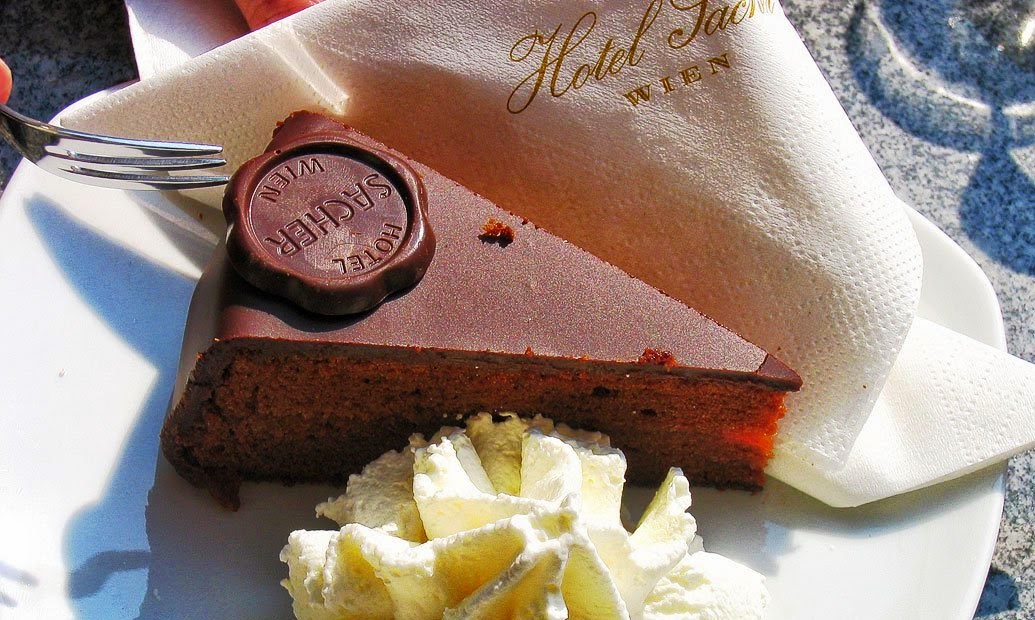
We will return to places we enjoyed before and see others we missed—like the museum located in Sigmund Freud’s old apartment and office, where psychoanalysis was born. There is a famous coffeehouse I want to return to, CafĂ© Sperl, and of course we will return—perhaps even daily—to the Sacher
SACHER TORTE!
Hotel to partake of its stupendous culinary creation, the Sacher torte. Then there will be the museums and palaces of the old Hapsburg Empire and the Mozart concerts in old churches.


So much for frivolity! In addition, I will be researching some of these locations and many more for inspiration for my third mystery in the Austin Starr series. I know, I know. The second one, RAINY DAY WOMEN, isn’t even published officially until July 7, but I am keen to begin my next writing project.

In this new book my amateur sleuth Austin Starr will get ensnared in an East-West spy plot when she accompanies her husband David to an academic conference in Vienna. As I’ve often stated, I’m a student of the Cold War years—a fan, sort of—and Vienna was the epicenter for spying during many of those years.


If you’ve seen the beloved classic film THE THIN MAN, then you have some idea of what I’m talking about. After World War II, the victorious Allied powers divided control of Austria and its capital city, Vienna. This stage lasted from 1945 to 1955 as the Western powers (the U.S., Great Britain, and France) confronted their previous ally, the Soviet Union. As a consequence, both sides—West as well as East—had their spies entrenched and embattled in Vienna for a decade. 

The problems caused by divided control of Berlin culminated in the building of the Berlin Wall in 1961 and then ultimately its tearing down in 1989. The historic period of a divided Vienna is less well known, and Austria’s geographic location—providing a nexus between East and West—ensured that tensions would remain high even after Austria gained self-government in 1955. Fourteen years after that, I will plunk my poor unsuspecting amateur sleuth into a hornet’s nest of spies.

 All that political turmoil lends itself to drama, intrigue, and murder. So you bet I can hardly wait to dig into Vienna. While Austin Starr will come along for the ride—at least in my brain—my three house rabbits have to stay home with the dog. But don’t worry about them too much. The live-in pet sitter we hire spoils them rotten while we are away.
~~~~~~~


Kay Kendall is a long-time fan of historical mysteries and now writes atmospheric mysteries that  capture the spirit and turbulence of the sixties. She is also an award-winning international PR executive who lives in Texas with her husband, three house rabbits, and spaniel Wills. Terribly allergic to the bunnies, she loves them anyway! Her book titles show she’s a Bob Dylan buff too. RAINY DAY WOMEN publishes on July 7 and is the second in her Austin Starr mystery series. The E-book version is available for pre-order now and the trade paperback will be soon. 

Tuesday, May 19, 2015

Connie Johnson Hambley is my guest today


I'm thrilled to introduce you to Connie Johnson Hambley who is taking my spot for the day.

I asked her to tell me a bit about her book, The Troubles, and this is what she told me..


I’m so excited to be a guest of the Stiletto Gang! Hi all! (or for some, that would be “Hi, y’all!”)
This week marks the launch of my second thriller. “The Troubles” continues the story of Jessica Wyeth, a woman whose family was destroyed by the business of terrorism. I know–business? There is more to an act of terrorism than two kids with backpacks or a truck filled with explosives. My books go into the world beyond the obvious to explore the how’s, why’s and who’s of terrorism and its impact.

I have people ask me why I wrote “The Troubles.” The simple answer is that my readers wanted to know what happens to Jessica after the end of “The Charity,” the first book in the series. In “The Charity,” Jessica discovered her world of comfort and security in a nuclear family is not what it appeared to be. She stumbled upon a money laundering scheme for the Irish Republican Army her father’s business was involved in and was forced to hide after being framed for murder. The process of untangling herself from that mess made readers fall in love with her grit and resourcefulness. They related to her as a real person and wanted to know more. When they asked for more, I realized I had the answers burrowed away inside of me. I wrote “The Troubles” to answer why Jessica’s birth mother hid her true identity.  Oh yeah, and to show whether Jessica ended up with the right guy––or not.

The harder answer of why I wrote this book is because I had to. I grew up in a small town in New York where my family was the target of an arsonist. I know what it feels like to live in a world where the bubble of security and safety has burst. Subtle and pervasive fear shapes who we are in unseen ways. What drives a person to do an extreme act? A theme in my books is that truth is in the eye of the beholder. Answers are not black and white, and good is shaded by evil. Sometimes, being seen as a freedom fighter or a terrorist depends on which side of the match––or gun or bomb––you’re on. We live in an increasingly complex world and I believe these themes are worthy of exploration.

I use real events to tell my stories. “The Troubles” unfolds several mysteries at once by taking the reader into Northern Ireland’s unrest and into Jessica’s mother’s life. Is giving your daughter away at birth a selfish act or one of profound love? The story brings the readers to the Irelands and England and into the world of high-stakes horse training.

“The Troubles” is available for pre-orders with a release date of May 20.
I love chatting with readers, so please find me on Twitter @conniehambley, and at my author page on Facebook!


Quick Summary:

On June 15, 1996, a box truck parked in front of the Marks & Spencer store in the Arndale shopping district of Manchester, England. Phone calls made to news organizations and police ensured no bystanders remained in the area when the truck exploded. The Irish Republican Army claimed responsibility.

Twenty years later, the crime remains unsolved.

Jessica Wyeth is no longer a fugitive hiding under assumed identities. Through sheer grit, she has reclaimed her life only to discover what she fought for was an illusion. She is not the child of the picture perfect New England family, but an unwanted castaway. Her frail and reclusive aunt died without exposing the secret that she was Jessica’s mother. Jessica travels to Ireland – her mother’s home – to learn why.

When Jessica rides a world-class steeplechase, she is unwittingly used as an accomplice for a devastating bombing in an English shopping mall. The group behind the bombing is the Charity, a generations old support network of the IRA. Michael Conant, reluctant heir to the Charity and Jessica’s lover, must choose his allegiance to his violent family legacy or the woman he loves. Meanwhile, Jessica’s fight for her life leads her to uncover her mother’s secrets and the divided soul of the Irelands.

The Troubles is a high-concept suspense novel that views the conflict in Northern Ireland through the prism of American involvement. With vision, desire, and an ever-unfolding world, The Troubles is a sweeping, multi-generational tale.


Bio:

Connie Johnson Hambley grew up on a small dairy farm just north of New York City. When she was five years old, an arsonist burned her family’s barn to the ground. Memories from that experience grew the stories that have become The Charity and The Troubles.

Hambley uses every bit of personal experience to create a story that is as believable as it is suspenseful. Leveraging her law and investment background in ways unique, creative, but not altogether logical, she has enjoyed robust professional pursuits that include writing for Bloomberg BusinessWeek, Massachusetts High Tech, and Nature Biotechnology. Proving that truth can be stranger than fiction, her experience at a major bank in Boston introduced her to the clever schemes people dream up to launder money.

Interviews include: Boston’s Literati Scene TV Show; Hallie Ephron of Jungle Red Writers: Ireland, Horses and Senseless Fire; Pawling Public Radio; Blog Talk Radio; Rounded Corner of the Writing World; (Australian Author) Penny de Byl’s Five Minute Profile; and Poughkeepsie Journal In Minutes, A Generation’s Work Destroyed by Flames.

Hambley writes page-turners and The Charity is the first in a series. Its sequel, The Troubles is due out May 2015. Look for updates and information on facebook.com/thecharitythriller and  www.conniejohnsonhambley.com/

Hambley writes about strong women from their perspective in situations that demand the most from them. No special powers, no gadgets, no super human abilities. Just a woman caught up or embroiled in something that she has to get out of, hopefully alive.

Find her at:
Twitter: @conniehambley


Monday, May 18, 2015

Dialogue--To Say and Convey

I feel fortunate this year to have had several opportunities to teach (and learn) about dialogue. I come from a theatre background, so I’ve always felt comfortable writing what characters say. It wasn’t until I studied the mechanics of what makes dialogue readable, that I realized there are a few techniques that can really improve not only the speech, but also the way it enhances the story.

The www.oxforddictionaries.com defines “dialogue” as “conversation between two or more people as a feature of a book, play, or movie.” While fictional dialogue resembles conversation, it is not an exact transcription. Readers would soon tire of actual exchanges. Consider the number of times people say throw away words or syllables like “you know” or “uh.” Watch close captioned programing and see how difficult it is to capture exactly all the spoken phrases and word spellings. It’s tortuous.

To really be beneficial in developing a story, the dialogue must be an integral part of the plot, the pacing, and the entire purpose of the work. It’s crucial that dialogue identify the speaker and reveal the character by speech pattern and attribution (either “tags,” such as he said or she said, or “beats,” which are character actions placed close to the spoken words). In addition, dialogue needs to blend into the story becoming invisible to the reader so it advances the story without distracting or interfering with its progress.

At this year’s Murder in the Magic City, an annual mystery conference held in Birmingham, Alabama, Guest of Honor Craig Johnson (author of the Longmire series) mentioned that George Guidall, who reads the audio versions of the books, told him: “You don’t clutter your writing with attribution and that makes it easier to read.” This comment resonated very strongly with me, bringing home two important points: (1) it’s important to read your story aloud, particularly the dialogue, to see if it flows naturally and feels comfortable being spoken, and (2) any dialogue that doesn’t keep the story moving has to go.

Here’s a checklist of recommendations for writing dialogue that I developed from my studies:

For clarity, each time a speaker changes, give the new speaker a new paragraph.

Be careful about using a character action as a tag.
Examples of bad tags: “No,” he coughed. / “No,” she hissed.
You can’t cough a word, nor can you hiss a word that does not contain an “s.”
Improvement: The racking cough almost kept him from speaking. Finally, he was able to say, “No.”
Appropriate use of “hiss”: “”Yes,” she hissed.

Use adverbs sparingly. A character might say something softly instead of whispering; but if you describe him as speaking adamantly or sarcastically, think about substituting a beat (He slammed his fist on the table/She smirked) for the tag (he said adamantly/she said sarcastically). Remember show, don’t tell.

Vary tags and beats. If it’s clear who’s speaking, you may not need either.

Punctuate dialogue with commas and periods. Use exclamation marks sparingly. Generally, people don’t speak in semi-colons.

Match dialogue with your character and make sure it reflects your character’s voice.

Limit and be consistent in use of dialect and phonetically spelled speech. Let it enhance character development, not confuse the reader.

Don’t use character names in dialogue unless they are needed for clarity or emphasis. Remember how you knew you were in trouble as a child when you heard your parent call you by your full name?

Know when silence or the unspoken speaks volumes.

Following are some books and online resources I’ve found helpful:

1.                  Dynamic Dialogue: Letting Your Story Speak by William Bernhardt (Red Sneaker Writers Book Series 4) (Babylon Books, February 3, 2014).

2.                  Dialogue by Marcy Kennedy (Busy Writer's Guides Book 3) (Tongue Untied Communications, February 26, 2014).

3.                  Dialogue - The Ultimate Writers' Guide by Robyn Opie Parnell (R&R Books Film Music, July 23, 2014).

4.                  Dialogue Tips & Traps: A Guide for Fiction Writers by Brent Spencer (Writers Workshop Press, June 25, 2012).

5.                  Hallie Ephron’s article at: http://www.netplaces.com/writing-your-first-novel/writing-dialogue/writing-believable-dialogue.htm

6.                  Marcy Kennedy’s dialogue blog messages at: http://marcykennedy.com/

 A legislative attorney and former law librarian, Paula Gail Benson’s short stories have been published in Kings River Life, the Bethlehem Writers Roundtable, Mystery Times Ten 2013 (Buddhapuss Ink), A Tall Ship, a Star, and Plunder (Dark Oak Press and Media, 2014), and A Shaker of Margaritas: That Mysterious Woman (Mozark Press 2014). Her most recent short story, “The Train’s on the Tracks,” is in Fish or Cut Bait: the third Guppy Anthology (Wildside Press 2015).

Friday, May 15, 2015

Visualizing Success


By Linda Rodriguez
One of the best books on actually living a writer’s life is Making a Literary Life by Carolyn See. I often give it as a gift to serious aspiring writers I know. Carolyn is herself an award-winning novelist, and her advice is pretty solid. (I have come to feel as if she is my friend from reading her novels and this book again and again, but though I’m on first-name basis with her here, I’ve never actually met Carolyn See.)

First, she tells us to write 1,000 words a day every day. Blam! Just like that! Right at the beginning! But she says they don’t have to be finished words—they don’t even have to be good words. We just have to put down 1,000 words every day. And of course, it works—because no one will be able to keep slapping random words on the page. We start to make sense, and then we start to make story. So, her rule number one is write 1,000 words each and every day.

Carolyn’s next rule will prompt groans from everyone. She talks about the need to build a writing community and to get involved in the writing community that already exists. So she wants us all to write a charming note each day to a different writer or editor or agent or reading series administrator, expressing our genuine appreciation for something they’ve done or written. I suspect this will be the biggest stumbling block among her rules for living the writing life, even though I’ve come to see the sense of it. (I must admit I don’t follow this rule very often, though, being no better than any of the rest of us.)

The rules continue throughout this informal and witty book, and they are all good rules. When I abide by them, I am in better shape than when I don’t. This I know. However, it’s another part of the book that I want to talk about here.
 Carolyn makes a great case for visualizing the career and life we want to live as writers. She talks about well-known writers who have entourages, chauffeurs, phalanxes of attractive bodyguards, or dramatic capes and trench coats. She makes a persuasive case that each of these successful writers had at some time in the past decided, consciously or unconsciously, that when they were successful they would have—entourages/ chauffeurs/ bodyguards/ trench coats.

Carolyn encourages us to consciously visualize the successful writer’s life we want to have in the future in detail, including what we’ll wear, if that’s important to us, what friends we’ll have, where we’ll live, and more. That kind of visualization is important, I think. If we don’t put some thought into what we want, how will we know when we’ve achieved it? She encourages us to go into detail because some of the details are easier to achieve than others. It’s very tough to make the New York Times bestseller list, but it’s not so hard to save up for a splashy cape or dramatic trench coat.

So my question to all of you today, as well as to myself, is what would your life look like if you achieved the kind of writer’s success that you long to have?

I’m not into splashy capes or trench coats or matched pairs of bodyguards, but I think a chauffeur might be a nice achievement, especially on regular professional visits to New York City (which are very much a part of my visualization). Actually, I think I’ve already achieved this.
On my last trip to NYC to meet with my editor and attend a poetry award ceremony, I found a livery car service that took us all over the city at all hours and for less than a cab would have cost. After the post-award-ceremony bash, native New Yorkers in our party were futilely trying to gain the attention of cabs outside the restaurant while one phone call brought our driver to pick us up in front and take us across town to our B&B.

What would you visualize for your life as a successful writer? Inquiring minds want to know!

REPLIES TO COMMENTS (because Blogger):

Marilyn, how big is big? The power's in the specificity of the details. Do you want a fan base of 100,000? 600,000?

Mary, yes, first-class travel might well be a perk to visualize. A cook/nutritionist would help you stay in good shape so you could turn out more of your books.

Judith, the idea of ease is a great one. Things that make the different tasks we face easier for us will always be a favorite.