Showing posts with label Cold War. Show all posts

Wednesday, May 20, 2015

Multi-tasking at Its Finest

By Kay Kendall 

By the time you are reading this posting, I will be busily multi-tasking in Vienna, Austria. This two-week trip with my husband combines a boatload of pleasures and missions. First, it marks our fortieth wedding anniversary and also the completion of Bruce’s arduous treatments for neck cancer only four months ago. So what if our pace will be slower than on previous journeys? We will be there and thankful. Many years ago we spent three days in Vienna and always vowed to return. This is our time.


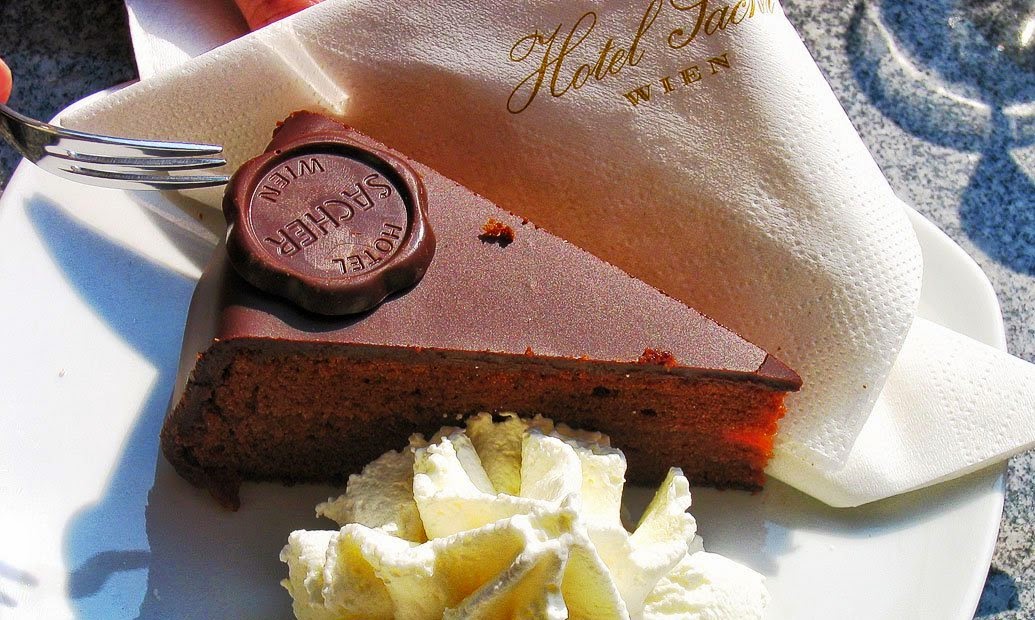
We will return to places we enjoyed before and see others we missed—like the museum located in Sigmund Freud’s old apartment and office, where psychoanalysis was born. There is a famous coffeehouse I want to return to, Café Sperl, and of course we will return—perhaps even daily—to the Sacher
SACHER TORTE!
Hotel to partake of its stupendous culinary creation, the Sacher torte. Then there will be the museums and palaces of the old Hapsburg Empire and the Mozart concerts in old churches.


So much for frivolity! In addition, I will be researching some of these locations and many more for inspiration for my third mystery in the Austin Starr series. I know, I know. The second one, RAINY DAY WOMEN, isn’t even published officially until July 7, but I am keen to begin my next writing project.

In this new book my amateur sleuth Austin Starr will get ensnared in an East-West spy plot when she accompanies her husband David to an academic conference in Vienna. As I’ve often stated, I’m a student of the Cold War years—a fan, sort of—and Vienna was the epicenter for spying during many of those years.


If you’ve seen the beloved classic film THE THIN MAN, then you have some idea of what I’m talking about. After World War II, the victorious Allied powers divided control of Austria and its capital city, Vienna. This stage lasted from 1945 to 1955 as the Western powers (the U.S., Great Britain, and France) confronted their previous ally, the Soviet Union. As a consequence, both sides—West as well as East—had their spies entrenched and embattled in Vienna for a decade. 

The problems caused by divided control of Berlin culminated in the building of the Berlin Wall in 1961 and then ultimately its tearing down in 1989. The historic period of a divided Vienna is less well known, and Austria’s geographic location—providing a nexus between East and West—ensured that tensions would remain high even after Austria gained self-government in 1955. Fourteen years after that, I will plunk my poor unsuspecting amateur sleuth into a hornet’s nest of spies.

 All that political turmoil lends itself to drama, intrigue, and murder. So you bet I can hardly wait to dig into Vienna. While Austin Starr will come along for the ride—at least in my brain—my three house rabbits have to stay home with the dog. But don’t worry about them too much. The live-in pet sitter we hire spoils them rotten while we are away.
~~~~~~~


Kay Kendall is a long-time fan of historical mysteries and now writes atmospheric mysteries that  capture the spirit and turbulence of the sixties. She is also an award-winning international PR executive who lives in Texas with her husband, three house rabbits, and spaniel Wills. Terribly allergic to the bunnies, she loves them anyway! Her book titles show she’s a Bob Dylan buff too. RAINY DAY WOMEN publishes on July 7 and is the second in her Austin Starr mystery series. The E-book version is available for pre-order now and the trade paperback will be soon. 

Wednesday, September 3, 2014

Big Macs, Moscow, and My Epitaph

By Kay Kendall

Twenty-four years ago I decided to write my own epitaph. On my tombstone would be these words—She led the worldwide publicity when McDonald’s opened in Moscow. Although I sensed my PR career was not near its end, I also realized I would never have a greater triumph.

The first Moscow McDonald’s opened on January 31, 1990, when the world held five billion people. Media monitoring showed the success of our publicity. Three billion knew 
the Golden Arches of capitalist fame were now installed only blocks from Moscow’s Kremlin, behind whose walls worked Soviet communism’s leaders. Russians will recall the symbolism—how the restaurant’s opening heralded their government’s increased openness to the West. In the two-plus decades since the flagship store debuted in Moscow’s Pushkin Square, the number of McDonald’s in Russia grew to more than 400.

Now Russia’s relationship to the West is changing again, while media commentators herald a renewed Cold War. And one aspect of that relates to McDonald’s. Two weeks ago, the Russian government closed the McDonald’s flagship for so-called health violations, and gradually more and more McDonald’s are being shuttered, across Moscow and in other Russian cities too. Once again, Moscow McDonald’s has become a symbol and snagged worldwide media attention. My pals in the US, UK, and Canada email news reports that show photos of the opening, and I know I was there, in that crowd. 

Two decades of negotiation by the Canadian wing of McDonald’s lay behind the event. George Cohon, CEO of Canadian McDonald’s, led the charge. It was personal for him. His grandfather was born in the same Russian village as the grandfather of Brezhnev, leader of the USSR when Cohon began his quest.  For political reasons, the U.S. parent company kept hands off. Back then only joint ventures with foreign companies were allowed by Soviet law, so McDonald’s partner was the Moscow City Council.

The restaurant accepted only Russian rubles, not hard currency. Due to Soviet shortages, the company developed its own supply chain in the Soviet Union, and the company prided itself on sourcing everything within the USSR. I remember meeting potato experts who had come from the province of New Brunswick (Canada's equivalent to Idaho in terms of potato excellence) to teach Russian farmers how to grow better potatoes for their fries. When Cohon wrote his autobiography he called it To Russia with Fries.

Just as Cohon’s long campaign to take McDonald’s into Russia was personal for him, so my participation was emotional for me. Not only was it the triumph of my public relations career, it also took me back to the USSR at an exciting time, made even more meaningful because of an earlier seminal visit.

By a fluke,* as an undergraduate I had studied Russian at a language institute in the USSR and then got bitten by the Russian bug. The tragic past, the indomitable spirit of the Russian people, the exotic architecture of the tsars—all this and more intoxicated me. I also wanted to understand America’s Cold War enemy. Russia was novel for someone who knew only Kansas and Texas well. My love affair with Russia was deep and compelling, driving me to earn degrees in Russian and Soviet history.

That student trip to the USSR was in the sixties, and I only returned two decades later with McDonald’s. My four long stays in Moscow during 1989-1990 came at a critical time. The Berlin Wall fell, and Soviet leader Gorbachev indicated the Soviet Union might be allowed to grow more democratic overnight. With all the Russian history I had been immersed in, I understood the enormity of the potential change and was beyond thrilled with my good fortune, working in Russia at such an electrifying time.

On my final trip to Moscow for the grand opening, I walked up to the airline counter in Toronto. The woman checking me in asked how many pieces of luggage I had to declare. “One hundred twenty,” I replied.  Yes, the launch of Moscow McDonald’s was a mammoth undertaking—and my load was only for the publicity.

Many scenes at the grand opening were intense. Moscow police warned us terrorists were driving around the city in a van with a small nuclear device inside. Chechens intended to make a statement by blowing up the new McDonald’s, and hundreds of world media were on hand to report the catastrophe. (That is, if they survived!)  My PR team grew nervous, but we were too busy to stop and worry much.

One photojournalist sent from a London tabloid wept when he got scooped by another paper. He had failed his assignment—to capture on film the first sale of a Big Mac in Moscow.

Speaking of tears, on opening day, one elderly babushka cried when she got her package of sandwiches and french fries. One man bought two bags full of Big Macs to carry home to his relatives living thousands of miles away in Novosibirsk. All the customers on opening day (also for months afterwards) stood in line for hours before they were served. Even with twenty-seven cash registers working full-time, the lines stretched for blocks outside Moscow McDonald’s.

Memories of those glorious days fill me now. I recall the severity of Russian weather that January of 1990—even though I had already endured the snows of Ontario for many years with my Canadian husband. In Moscow I trudged through knee-deep drifts, visiting international media outlets in person, hand-delivering news releases. Just imagine—how quaint. Yet that was more efficient than faxing, since there weren't enough telephone lines for use in Moscow. Our team already monopolized too many with calls back to North America. I stayed long enough in Moscow to hear native speakers say I had developed the accent of a Muscovite. Finally, my Russian language ability was gaining traction.

But those recollections mean more to me than they would to you. Suffice it to say, with my love of the sweep of history, the latest change in Russia’s relations with the West saddens me. I would like to think that history marches on towards harmony and light, but my studies tell me that is not true. So I cling to precious memories of my last stay in Moscow.

My room was in the National Hotel, only two doors away from the room Lenin had occupied—right after he grabbed ultimate power in Russia. That was long before, in 1917, when workers and soldiers hoped for a brighter future after their revolution. We never do know where history will take us, do we? 
________

 * I believe in lucky flukes. The headhunter who called me for the McDonald's assignment had no idea I knew Russian. She was looking for someone to "take a tough assignment" and figured I could handle it since I was already VP of public affairs for another huge American corporation at its Toronto office. When she gave me sketchy details on the job possibility, I said, "I have visions of Big Macs." She laughed and replied, "Oh, could be." Thank goodness I read the papers and knew all about McDonald's Russian adventure. In fact, the year before at a cocktail party, I had met George Cohon and offered my PR services. The headhunter's call had nothing to do with that. It was mere luck. 

~~~~~~~

Kay Kendall is an international award-winning public relations executive who lives in Texas with her Canadian husband, three house rabbits, and spaniel Wills. Growing up during the Cold War, she grew excited when an ICBM (intercontinental ballistic missile) was installed near her hometown in Kansas. A fan of historical mysteries and the brilliant spy novels of John le Carré, she set her debut mystery DESOLATION ROW during the Vietnam War, a key conflict of last century not already overrun with novels.

Wednesday, March 5, 2014

Cold War Terrors--Redux!

By Kay Kendall

The lure of historic catastrophe hit when I was eight. On the movie screen a small American town celebrated the return of victorious soldiers from World War I. How exciting it must’ve been to live during real wartime, I thought.

Even at that tender age I knew America was engaged in a dangerous cold war with a vicious enemy, the Soviet Union. This massive Euro-Asian power—encompassing the former Russian empire plus pieces of the Hapsburg monarchy—threatened my freedom. If the US-USSR stalemate heated up, there would be drama and chances for glory ahead.
Soviet leader Nikita Khrushchev said the USSR would "bury" the West. 

What did I know about war? (In my own way, I must have been as naïve as those deluded British soldiers in August 1914 who marched off to fight the Hun in what became World War I, feeling sure they’d be home by Christmas.)   

Flash forward nine years. The Cuban missile crisis pushed the entire world to the brink of Armageddon. Only six hours before Khrushchev blinked—promising to withdraw his missiles from Cuba—I took my SAT exams. What the heck, I thought. If everyone faced nuclear annihilation, then I had little at stake and wouldn’t take my college entrance exams so seriously.

Now, decades later, those memories flicker in my head while I watch events in Ukraine on my television screen. As I write this, Russia has troops in the Crimean region of Ukraine and even more troops and a thousand tanks ready to cross the border. Pro-Western riots in Kiev have resulted in deaths and have been answered by pro-Russian protests, perhaps Kremlin-instigated. Centuries of ethnic bloodshed in this region lie behind these events.

Russian President Vladimir Putin says “extraordinary” circumstances allow him to send troops into Ukraine to protect ethnic Russians there. Meantime Ukrainian Prime Minister Arseny Yatseniuk says Russia has “invaded” his country and places his troops on high alert.

Media pundits debate what the West can do. One points to a meaningful statement that presages these events, made by Putin a year ago. The Russian leader said the collapse of the Soviet Union was the worst geopolitical event of the entire twentieth century. Yes, really! The foreign affairs analyst confidently predicts a resurgent Russia under the crafty hands of Putin, whose first name is the same as Lenin’s, who built the communist menace in the first place. Oh, the portents are bad indeed.

This new threat to the world’s balance of power is a long way from playing out. Who knows where events will lead next? What will China do? North Korea? This may be high drama, but it is not entertainment. This is not fun. All these nations have nuclear weaponry. Are we in fact entering a new version of the old Cold War, or will things suddenly turn hot? Red hot?

Many people clamor for fiction that features massive annihilation as a backdrop.

How do we explain being drawn to spy stories, horror movies, serial killers’ tales and the like? As a writer who kills fictive people for a living, I ponder this quite a lot.

I believe fiction like this works because it shows how people can act valiantly in ruinous times, overcome their fears, and emerge on top. When we read novels set during past wars, we can get scared but we'll know how things turn out. The Nazis always lose, even if a few survive to plot another day.

As indicated, I grew up when the Cold War was in fact pretty hot. An intercontinental ballistic missile was placed a few miles from my hometown in Kansas when I was in grade school. That excited me, rather than terrifying me. Serious tomes were written about “thinking the unthinkable.” Yet, to me, the unthinkable was preposterous. I assumed that mutually assured nuclear destruction would work as a deterrent. Surely rationality would prevail. Anything else would be unreal. In a word, fiction.

I moved rapidly from a severe case of Nancy Drew-itis to being mesmerized by John le Carré’s twisted spy stories. Smiley, his British master spy, was always at pains not to let the ends justify any means. His adversary on the other side of the Iron Curtain, Soviet master spy Karla, seemed to lack all scruples and toyed with him, playing a vicious cat-and-mouse game. Smiley’s bed-hopping wife Anne even got ensnared.  

When I finally felt compelled to devise my own mysteries, it was natural to turn to my favorites as models. For two years I drowned myself in mysteries set during World Wars One and Two and the Cold War. There were so many excellent ones—too many, actually. Of all the major wars of last century, only the wars in Korea and Vietnam weren’t “taken,” weren’t overrun with thrillers. Vietnam offered a dangerous yet fairly empty gap that needed filling…and I concluded I’d do the filling.

What I studied in college and graduate school was Russian history. Obviously the Cold War fascinated me. These days, in our a-historic times, it’s important to recall why the United States got mired down in fighting a land war in Asia in the first place. The domino theory supplied the reason. If South Vietnam fell to the communists pushing down from North Vietnam, then that domino would fall and knock down another Asian country and another until they all fell into communist hands.

My penchant for historical wars helps explain why my debut mystery is set among the draft resister community in Toronto, Canada, ca. 1968. I enjoy writing about historical turmoil that lends itself to personal drama, intrigue, and murder; I can control the world that I build on the page. That is comforting.

But now I must return to my television screen, to wait for the newscasters to tell me that the crisis in Ukraine is escalating, waning, or mutating in some as yet unforeseen fashion. I watch, mesmerized, waiting for comfort to come, even if it is only temporary. Only until the next geopolitical horror fills my screen, or screeches from the headlines of the New York Times. Sadder and wiser than in my youth, I no longer trust the nuclear deterrent to work.

*******

Kay Kendall is an international award-winning public relations executive who lives in Texas
Kay & house bunny Dusty
with her husband, five house rabbits, and spaniel Wills. A fan of historical mysteries, she wants to do for the 1960s what novelist Alan Furst does for Europe in the 1930s during Hitler's rise to power--write atmospheric mysteries that capture the spirit of the age.


Discover more about DESOLATION ROW, here at
http://www.KayKendallAuthor.com