Showing posts with label research. Show all posts

Friday, May 13, 2022

Why 'Google' Isn't a Synonym for 'Research'

WHY ‘GOOGLE’ ISN’T A SYNONYM FOR ‘RESEARCH’ by Connie Berry

The quote about Google and research belongs to author Dan Brown, who himself undoubtedly spent days, weeks, months researching his complicated thrillers and was accused (but not convicted) of lifting information from books, journals, and blogs written by others which were available online. So, what was he talking about? There’s so much information on the web. Isn’t Googling information a good way to research a book in this day and age?

We all know research can be a black hole, sucking up precious time while deceiving us into thinking we’re accomplishing something. That’s one problem. The bigger problem for me is deciding how much of that fascinating research to include in the book. Here’s an example from my brand-new mystery, The Shadow of Memory.

When my characters travel from one location to another, I ask questions. What kind of terrain will they encounter at that time of year? Are there any landmarks or unusual features that will capture their attention? Since I can’t always be in the UK, I have Google Earth. Which leads to Wikipedia and all

sorts of information connected with my story. While researching Vivian Bunn and Kate’s drive from Long Barston to the fictional village of Upford, for example, I happened upon the quaintly named “crinkle-crankle walls,” typical of East Anglia. I was captivated.

In an early draft of the novel, Vivian Bunn is reading to Kate about local history as they drive:

“It says there’s no market in Upford anymore,” Vivian said. She was reading something

on my cell phone again. “Their claim to fame is a crinkle-crankle wall running along the main north-south road—smaller than the more famous one at Easton but just as picturesque.” She looked up. “I’ve seen the one at Easton.”

“What does crinkle-crankle mean?”

“Let’s find out.” She peered at my phone screen. “A crinkle-crankle wall is an unusual type of serpentine garden wall found mostly in East Anglia and especially in Suffolk. The walls began appearing in the seventeenth century when Dutch engineers were draining the fens. Because of their stability, they were especially well suited to the soggy, unstable ground. Sometimes as many as fifty bricks high, they actually require fewer bricks than a straight wall—Really? I wouldn’t have thought that—because a wavy wall can be built one-brick thick whereas a straight wall needs at least two layers of bricks. The American president Thomas Jefferson incorporated serpentine walls into the architecture of the University of Virginia, which he founded in— Look! She screeched so suddenly I nearly veered off the road. “There it is.”

Sure enough—a sinuous red-brick wall snaked along the road on our right. We were so taken by the sight, we almost missed the turning toward the village center.

Yes, I was beguiled by my research. No, crinkle-crankle walls had absolutely nothing to do with the story. They needed to go. Here’s the final version: 

The address we’d found for the Beaufoys—Wren Cottage, 27 Bramble Walk—led us to

           the east side of the market town of Upford, close to the Essex border. A sinuous red-brick

           wall snaked along the road on the right. We were so taken by the sight, we almost missed

            the turning toward the village center.

The problem with research-by-Google is too much information and the temptation to include it in the book. I’ve learned my lesson. Now, when I’m tempted to chuck in that captivating bit of research, I ask myself four questions:

1. Is this information necessary to orient the reader in the scene?

2. Does it draw the reader in emotionally or viscerally so she is experiencing the scene along

    with the characters?

3. Does the information move the plot forward in any way?

4. Does it reveal anything significant about the characters?

If my answer is four “no’s,” I leave it out.

What is the most interesting piece of information you’ve ever found while researching a book?

Did it make it into the finished manuscript, or did you end up cutting it out?

~ ~ ~ ~ ~

Connie Berry writes the Kate Hamilton Mysteries, set in the UK and featuring an American antiques dealer with a gift for solving crimes. She was raised by antiques dealers who instilled in her a passion for history, fine art, and travel. Her debut novel won an IPPY Gold and was an Agatha Award finalist. Connie is a member of MWA, CWA, and SinC. She loves history, foreign travel, cute animals, and all things British.


Monday, June 14, 2021

Crossword Puzzles or a Writer's Research


by: Donnell Ann Bell 


“What’s a three-letter word for expert?” my husband asks as I’m getting a glass of water before returning to my office. I stiffen. Here it comes, where I should be concentrating on three letters my brain turns into a giant mushroom cloud and I think of every word under the sun meaning expert, including, adept, proficient, and skillful, sans one with three letters.


“You know,” he says, reading glasses perched on his nose, “Daily mind games keep your mind sharp.”


I swallow some of my water and say, “So you’ve said. See you later, you know where I’ll be.”


What he doesn’t get is that while he works crosswords, Sudoku and other puzzles our doctors insist keep our minds sharp, I work mind games all day long.


I do research!  What’s more the research I do has to. . . you guessed it . . . fit into a puzzle.  Further, that research has to appear seamless and relevant, or you can come up with a pacing problem or worse, tell the reader you’re DOING research.  As a new writer years ago, my critique partner laid a dreadful accusation at my feet, saying, “Your research is showing.”


Talk about red-faced. You never ever want your research to show. It’s akin to a plumber’s crack or a piece of toilet paper clinging to your shoe.


Here’s something that puzzles me, and I’ve often asked myself why I don’t write less complicated books. The only answer I’ve come up with is I love suspense, police procedure and want to address the topics that interest me in my writing.  I want to understand more divergent topics that I normally wouldn't come across in my ordinary world. I love thwarting my protagonists, then watching THEM work to outwit the antagonist.


Wouldn’t it be incredible to hold all the answers in our heads as we wrote our novels? Certainly would be simpler and imagine the productivity. But then, what fun would that be? And how would existing knowledge stretch our imaginations? I love discovering new avenues, further knocking around the plot with Lois Winston, my very smart critique partner, then brainstorming with experts.

One thing my husband and I are fairly equal at is Jeopardy. We watch it most evenings at 6 p.m. What’s a three-letter word for expert? Try ACE.  Do you love puzzles? Research? Both? Something else that keeps your brain churning? I’d love to know.


About the Author:  Donnell Ann Bell gave up her nonfiction career in newspapers and magazines because she was obsessed with the idea she could write a mystery or thriller. Years later, she is an award-winning author, including a 2020 Colorado Book Award finalist for her latest release Black Pearl, a Cold Case Suspense. Donnell’s other books include Buried Agendas, Betrayed, Deadly Recall and the Past Came Hunting, all of which have been Amazon bestsellers. Currently she’s submitted book two of her cold case series to her publisher and is hard at work researching book three.  www.donnellannbell.com


Wednesday, February 17, 2021

Henry VIII, My Husband, and the Pissing Drunkard

Travel is a writer's perk. I've often journeyed far from home to research the world of my books.

For my historical novels, I tramped England in the footsteps of soldiers and queens. For my thriller The Experiment in which my heroine lives aboard her sailboat, I explored a funky New York City marina where a skipper took me sailing on Long Island Sound. For The Man from Spirit Creek I interviewed a ranching couple in northern Alberta who invited me to stay for dinner where I ate the best strawberry-rhubarb pie I’ve ever tasted.

In researching one book, though, I discovered an eye-opening resource close to home. My husband.


The Queen’s Lady is set in England during the reign of Henry VIII. Now, Henry and my husband share no similarity regarding tyrannical rule and beheaded wives – I married a thoughtful, peaceable man. He is, however, endowed with the standard issue male anatomy, and this helped my research.

Here’s how.

In my first draft of the novel, I’d written a scene of a Midsummer Eve celebration in which boisterous revelers dance around bonfires, lovers steal kisses, and a drunk old man pisses as he staggers through the crowd.

Wait a minute, I thought. Can a man do that – urinate while walking?

I took the problem to my husband. “Can a man do that?” I asked.

“I’ll go see,” he said, and walked out the door.

Thankfully, we lived then on sixty rural acres at the end of a dead-end road. Not a soul around.

Five minutes later he came back in. “Yup,” he reported.

You can see why I value this resource, right?

These days, with the pandemic keeping us all close to home, I’m lucky because I can turn to my husband again as a resource. I’m at work on a mystery novel in which the main character is an animal rights activist, and Stephen has worked with animal rights organizations for years. That’s him in the picture above, with an otter friend. His stories about the fine people who protect animals inspired this new book.  

I’ve enjoyed my travels, but right now close to home feels just fine.

Barbara Kyle is the author of the bestselling Thornleigh Saga series of historical novels (“Riveting Tudor drama” – USA Today) and of acclaimed thrillers. Over half a million copies of her books have been sold. Her latest is The Man from Spirit Creek, a novel of suspense. Barbara has taught hundreds of writers in her online classes and many have become award-winning authors. Page-Turner, her popular how-to book for writers, is available in print, e-book, and audiobook. Visit Barbara at www.BarbaraKyle.com  


 The Man from Spirit Creek 

When Liv Gardner arrives in the rural town of Spirit Creek, Alberta, she has nothing but her old car and a temporary job as paralegal with the local attorney. But Liv’s down-market persona is a ruse. She's actually in-house counsel of Falcon Oil, a small oil and gas company she co-owns with her fiancĂ©, CEO Mickey Havelock – and they are facing financial ruin.

Farmer Tom Wainwright, convinced that lethal “sour” gas killed his wife, is sabotaging Falcon’s rigs. But Wainwright is clever at hiding his tracks and the police have no evidence to charge him. With the sabotage forcing Falcon toward bankruptcy, Liv has come undercover to befriend Wainwright – and entrap him.

But Liv never dreamed she’d become torn between saving the company she and Mickey built and her feelings for the very man whose sabotage is ruining them. On a rain-swept night, Spirit Creek is stunned when one of their own is murdered. The evidence does more than point to Tom Wainwright . . . it shatters Liv’s world.

"A stunning thriller. A must-read with sabotage, murder, intrigue and romance." - Goodreads review


Page-Turner: Your Path to Writing a Novel that Publishers Want and Readers Buy

"Kyle is one of the few authors who can break down both the art and the craft of writing in a way that is entertaining and easy to understand.” — #1 New York Times bestselling author Kelley Armstrong


Friday, July 7, 2017

How to Get a Handle on Using Your Novel Research

by Linda Rodriguez


Research is vital for all fiction writers to a certain extent, and for those writing novels such as historical or science fiction or techno-thrillers, research can make or break their books. Yet research has its pitfalls and needs to be kept under control.

It’s always a mistake to allow research to consume the story you’re trying to tell. You can’t allow your desire to show off all of your great research to leave your narrative littered with details that slow down your pacing and clog up the narrative drive of your book. It’s often better to have something mentioned in passing and not defined or explained because your characters would know what it was. If you feel that some kind of explanation is needed for the readers, put it in context with a conversation, often joking, about some difficulty with the object or law or situation that uses the barest minimum of detail.

Another major issue—and probably the most important—in dealing with research is organizing it so that you can lay your hands on the item you need as you are writing that passage. There are several possible ways to organize research, and which is best depends on how your mind works and which you prefer to work with.

If you prefer to work with notes you take by hand or have a lot of physical documents to refer to, one or more portable file boxes with folders for each category of information—or period of time or whatever organizing principle you choose to use—will keep everything where you can readily access it. Binders are also a good way to keep track of notes, documents, printouts, and with enclosed pocket pages, smaller pieces of research or items that don’t lend themselves to lying flat or being hole-punched. You may even be a hardcore 3x5 card user, and you can find card files with dividers that allow you to organize these, as well.

If you prefer to do everything on the computer, you can set up in your word processer a master folder for the book full of lesser folders organized the way you would organize the physical files we talked about. You can also use a notes program, such as Evernote or One Note, which can be organized in any way you choose and can store photos, graphics, and videos, as well as allowing you to tag items with sources or cross-references.

Another good choice for technophiles is Scrivener or other similar book-writing programs, such as yWriter. Each of these allows you to add research notes to the actual chapter or scene where they will be used and then move them around, if need be. Scrivener also has a virtual 3x5 card function and a timeline function that can be a real lifesaver for complex books. Scrivener, of course, has many other functions, and a lot of my friends who are bestsellers swear by it. I intend to try it soon, but currently I use One Note for virtual information and a three-ring binder for physical items.

One of the things I always try to do is to keep a simple Word document going to which I add the names of everyone I’ve talked with to research a book. Then, when I need to write my acknowledgements page, I have that information at hand and don’t have to worry about forgetting anyone who helped me.

Chronology and timelines can be a real problem, not only for historical novelists and fantasy saga writers, but for others, such as mystery writers, who have to juggle the timeline of what really happened at the same time they are dealing with the timeline of how the protagonist solved the crime. For a simple timeline, you can keep track of things in your writing software, but for more complex or extensive timelines, you can either turn to Scrivener, which has a useful timeline function, or many of the other programs available online that deal with timelines only, such as Preceden, Aeon, Smartdraw, etc.

Of course, you can also go the old-fashioned way of constructing a comprehensive timeline to tape to your office wall, if you have a nice, long horizontal space available. If not, you can tape it in big chunks to large pieces of poster board and set them up against your wall or on a table or floor when you need to look at the entire timeline and perhaps shift something around on it.

Fortunately, there are many options for organizing research open to writers today. It’s simply a matter of choosing one or a combination of them that fits your mental style of working and using it religiously. That last bit is vital. You can have the best, most up-to-date method of organizing your research, but if you don’t use it consistently, it won’t support the work you’re trying to do. So, if you find yourself intimidated by the technological wonders, you might be better off using an old-fashioned file-folder system or binders you feel comfortable in using, rather than a state-of-the-art system you’re too nervous to use regularly. Research organization is for your benefit alone. You don’t have to impress anyone else, so use what really works for you.

How do you use research, if you're a writer? If you're a reader, have you seen good and bad research use in the novels you've read?


Wednesday, December 14, 2016

The Other Research

by Bethany Maines 

 After reading Paffi Flood’s article about that new Beaver Bum smell, I don’t feel so bad about today’s google searches, which include best easy-open pocket knives, MAPP gas, and a variety of facts about the Tacoma Police Department in 1922. My search history may imply an interest in violence, safe breaking and the local politics of the early twentieth century, but at least I have not learned anything horrifying about ice cream.


 It has been noted on more than one occasion that mystery writers tend to have rather disturbing research patterns. But really, of course we do. No one wants to get that detail about corpse bloat wrong. So embarrassing – how could I face the other writers at the conventions? But the other, less disturbing, research rarely gets mentioned. What gets served in high-school lunches these days? Hint: tater tots are still going strong. What are the three laws of robotics again? (Answer here) What brand would a black, vegetarian, female computer hacker smoke? Turns out it’s either Newport Menthols or American Spirit Organics. What do ballet dancers do strengthen their feet? (Video here)

 My point? There’s a lot more research that goes into a work of fiction than just what happened to the dead guy. But that research isn’t particularly titillating. It’s simply the stuff we bore you with at cocktail parties. What I find interesting is that almost every person I’ve ever met has been an expert in something, from baking, bagpiping, needlepoint, and cars, to wood working, plumbing, or how the brakes on busses work. I never know when I’m going to need that expertise, but I like to keep track of my various experts. After all, I never know when I’m going to need to know how to crash a bus full of bagpipers. Not that I would ever publically admit to mentally cataloging my acquaintances by how useful they could be to future research…

***
Bethany Maines is the author of the Carrie Mae Mysteries, Wild Waters, Tales from the City of Destiny and An Unseen Current.  You can also view the Carrie Mae youtube video or catch up with her on Twitter and Facebook.

Tuesday, August 23, 2016

Market Research

By Bethany Maines

As we have been exploring the question “Who are you like?” this month on the Stiletto Gang, I’ve been exploring what other books in my genres look like.  This is sometimes gratifying on the base level of my fonts are so much better than yours and also sometimes mystifying on the level of why are there so many bared midriffs in contemporary fantasy?  On the topic of midriffs, and purely for example’s sake, I’ll put the cover of Shifting Jock in Love here.  The cover is obviously… uh… fully functional, because I can’t stop staring at the uh… weight lifting bar.  Now that we’ve covered that topic (no, we haven’t covered anything?), let me move on to my point.

Market research, which is what I call shopping and (gently) making fun of book covers over a glass of wine, is important.  It’s hard to review my own book cover submissions if I don’t know what the trends are.  Not that trends should inform every decision, but I like to know how far out of the current I’m swimming. In addition to finding the occasional good idea that I could be copying, I also find really interesting authors.  Research shows that most people buy books based on word of mouth, but in this online age, that can’t ALWAYS be true.  From Facebook to google ads, to the wonders of Amazon, we get a lot of recommendations about authors and books online.  And without a person to ask, readers are stuck trying to answer “so who are they like” question based on the marketing surrounding the book.  But as we all learned in grade school, you can’t always judge a book by it’s cover.


One great resource I’ve found in my wading around the internet is a great website - www.literature-map.com  Simply type in an author you like and it will produce of an animated cloud of similar authors aka a handy new To Be Read list.  And you can click on the question mark in the corner if you want to add authors to the database to improve results.  And now if you’ll excuse me, I’m going to go enjoy a little more market research and a Riesling.


***
Bethany Maines is the author of the Carrie Mae Mysteries, Wild Waters, Tales from the City of Destiny and An Unseen Current.  You can also view the Carrie Mae youtube video or catch up with her on Twitter and Facebook.

Wednesday, May 27, 2015

Ask the Conductor

By Bethany Maines

Recently, I spent an hour at our historical documents library chasing down the names of the trolley stops between Tacoma and Spanaway Lake in the year 1914. Why, I hear you ask? What possible strange writer thing could I be up to? Is there a new novel in the works featuring a motorman’s adventures trying to the clear the name of a fellow conductor whose trolley appeared to take a turn too fast and go over an embankment fiery ball of flames in turn of the century Tacoma Washington? No, although now that you mention it, I would totally read that novel.


In fact this research mission was related to my day job – graphic design. While it’s rare for a design job to take me to the library, I strongly feel that both hats that I wear revolve around the same theme – I tell stories. Sometimes it’s in words and the stories are of my own in invention and sometimes it’s for a client who wants to showcase their unique narrative either in print or in the case of the trolley client on the side of their building. Yes, they take different skills, but at the end of the day, I feel like there’s a lot of overlap. Each project must have a beginning that sets the stage and leads the viewer/reader into main message and then conclude in a satisfactory manner. I think my ability to spot a narrative aids me in both lines of work. And of course, the benefit to being paid to research strange topics, is that who knows when a novel will require the use of my new found trolley knowledge.


Bethany Maines is the author of the Carrie Mae Mysteries, Tales from the City of Destiny and An Unseen Current.  You can also view the Carrie Mae youtube video or catch up with her on Twitter and Facebook.

Thursday, August 7, 2014

Confessions of a Research Slut

By guest Shannon Baker

Not everything about writing novels is great. It takes lots of time I could spend outside playing. I have to deal with the ugly face of rejection—more frequently than I’d like to admit. Trying to work out complicated plots hurts my head. Getting the words right with all the craft and expert writing advice swirling around my brain is enough to make me crazy(er).

One thing that is great about writing novels, though, aside from getting to play god to a world of my imagination, is research.

My plots and characters are often a product of the really cool stuff I learn while researching. For instance, when I moved to Flagstaff and found out about the controversy surrounding Snowbowl Ski area and man-made snow on a mountain peak sacred to thirteen tribes, I got curious. Off I traipsed with my brand new Flagstaff library card.

I stumbled across several books about the Hopi tribe. I was immediately hooked. This tiny tribe, destitute and insular, believes it is responsible for the balance of the world. The Whole World.

I did some in person research. One summer morning I drove a few hours to the Homolovi ruins north of Winslow. Along with a tour of the dwellings and ruins, a few Hopi tribal members talked about their farming technics and their reliance on native plants. One generous young man took the time to explain to me why the Hopi corn is planted in disarray instead of nice neat rows and why his corn grows green and strong in the arid climate. Let me give you a hint, it has little to do with fertilizer, barometric pressure and high and low fronts.

Hopi corn field
 Another day I ventured even further to a public dance at Second Mesa in Shipolovi. I was an obvious outsider. The Hopi haven’t been treated well by white folks in the past. Their sacred relics have been stolen, outsiders broadcast their secrets, and overall treated them with very little respect. The Hopi now have some pretty strict rules, such as no photography, no sketching, and they frown on note taking.

Their dance was amazing. I was so nervous I’d do something offensive, I stood as still and silent as possible and watched. But they wouldn’t let me be a fly on the wall. During one break, when the kachinas filed out of the plaza, the Hopi clowns gathered up all the white folks and sat us in the middle of the plaza. They had some good-natured fun with us and in the end, piled many gifts into our hands.

Because I don’t want to show actual photos from the mesas, I’m using this picture of kachina dolls to give you an idea of what a dance is like. Picture these as living beings and desert setting and pueblos.

My Hopi research turned up so many intriguing details of their history, culture, and beliefs I couldn’t address even a fraction in one book. So I was excited when Midnight Ink offered me a three-book deal. Tainted Mountain delves into the Hopi prophesies, explains a little bit about their ceremonies. It introduces kachinas and their role in Hopi lives.

For Broken Trust, I wanted to focus on a different aspect of Hopi’s connection with the world. According to Hopi beliefs, we now live in the fourth world and we’ve just about messed it up so badly we’re approaching the end of this world and emergence to the fifth world. Sad news for most of us, because not very many will survive to start the fifth world.

Since Hopi believe they hold the key to the Earth’s balance, they are concerned over climate change and extreme weather, and think these occurrences are due to their failure to perform all of the ceremonies. So many youth are draining from the three mesas they aren’t able to keep all of the clans vibrant. Every clan has specific duties to perform, so when one dwindles another clan must step in to perform duties not historically their own. 

Hand in hand with climate change is a shift in the Earth’s poles. The Hopi also have prophesied that "Turtle Island could turn over two or three times and the oceans could join hands and meet the sky." This seems to be a prophecy of a pole shift--a flipping, of the planet on its axis. The Hopi call this imminent condition Koyaanisqatsi, which means world out of balance, a state of life that calls for another way.

Hadn’t I heard of the Earth shifting on its axis? A little dive into that led me to Tesla, which led to incredible tales of limitless, cheap energy. Following that track took me to HAARP (the old Star Wars technology of the Cold War) and conspiracy theories about using weather as a weapon of mass destruction, and mind control. Which naturally took me to Jessie Ventura, as it would.
The most frustrating thing about the research is not being able to use all the neat stuff I learn. I guess it makes me a more well-rounded and informed person. I figure if I write enough books I’ll be the perfect dinner party guest.

Have any of you ever researched a topic just for fun?

Wednesday, April 9, 2014

How Much Research?

By Bethany Maines

So I was reading a book, which shall remain titleless to protect the guilty, and the heroine tucked her revolver into the simple elastic garter she was wearing under wedding dress, and I thought, “Well, that’s the last straw.” I didn’t finish the book because I just couldn’t handle the startling number inaccuracies that were in the first three chapters. I realize that as a karate practioner and the sister of a certified gun enthusiast that my opportunities for action scene research are rather broader than the average writers, but the fact that this writer couldn’t even be bothered to test the weight limits of an average wedding garter really bothered me.  The distance between research and creative license is always a fine one.  Researching until you can write an expert level on a subject results in Michael Crichton style tomes.  And I don’t know about you, but when I got to the “expert” section of those books, I just skipped to the end.  It’s my belief that there’s a level of detail that most readers don’t care about. Not all readers of course; I’m sure there are a great many people that really care about absolute accuracies of certain topics.  But in general, I think most readers just want a tale well told with the fewest obvious blunders.  What do you think? What level of research and accuracy is required from an author?


Bethany Maines is the author of the Carrie Mae Mystery series and Tales from the City of Destiny. You can also view the Carrie Mae youtube video or catch up with her on Twitter and Facebook.


Tuesday, July 23, 2013

Am I just crazy?

by: Joelle Charbonneau

So last night my mother, grandmother and I had an unexpected adventure at the ER.  Okay, my grandmother probably wouldn't refer to that particular trip in such positive terminology, but hey--I'm the one writing this so I get to label the trip to backless gowns and gurneys as I wish.  Right?  Technically, I can't blame my grandmother for her lack of enthusiasm for the journey to the hospital.  She was sick.  So far, it looks like a pesky viral infection was causing her issues.  Here's hoping that she'll be on the mend and avoid any other ambulance trips in the near future.

But while we were waiting for doctors and nurses and admitting staff, CT scans, blood work and all sorts of other tests, I found myself looking at this concerning situation with rose colored glasses.  I mean, needles and vocally unhappy patients (and there were a great number of those when we first arrived) aren't really my cup of tea but WOW was it all interesting.  I couldn't help looking at the people around me and wondering what their stories were.  I also found myself taking note of all the interesting gadgets in the place.  Heck, I've been in ERs before, but this was the first time I saw the cool flat screen monitor that listed every room number and displayed icons next to that room to show the treatment the patient was undergoing.  My personal favorite was the purple spaceship with the word ZOOM! above it.  The teddy bear was also cute, but made my heart ache a little since it was the symbol for a pediatric patient.  There were symbols for blood draws, Fall risks, various types of doctors and a whole lot of other things that made zero sense to me, but helped the staff know exactly what patient needed what when.

I was impressed and desperately wanted to ask dozens of questions.  How was the system developed?  How often is it updated?  Is that the main way the staff communicates in the ER?  How easy would it be for someone to bribe a staff member to update the board with the wrong test in order to learn something incriminating about the patient?

Oops...the writer in me is showing.

The thing is, while the ER adventure wasn't on my agenda tonight and clearly wasn't what I was interested in doing with my time, I found myself engaged by that world and the energy within it.  I couldn't help looking at it with fascination and instead of being irritated at the SLOW passage of time (and really--time does seem to pass at a turtle's pace in that place) I chose to look for the interesting things happening in those hours.

Which makes me wonder...am I just nuts for thinking that way or are other people wired the way I am? When stuck in a less than desirable situation do you look for the interesting and quirky in the adventure?  Do you think about what makes the place you're in tick and wonder at the personal stories of the real life characters that surround you?  If so, what's the last place you remember doing unexpected research or finding yourself entertained when you probably should have been tearing out your hair?  And if not - feel free to tell me I'm crazy.  Trust me, I won't be offended!

Thursday, November 1, 2012

Guest blog Jeri Westerson


Hi, it's Linda here. Please welcome my friend and gifted writer of historical mysteries, Jeri Westerson. Jeri's newest "medieval noir" Crispin Guest novel, Blood Lance, has just been published, and Jeri's going to talk to us about the really extreme research she does in order to write about her disgraced medieval knight.


She’s Armed
By Jeri Westerson

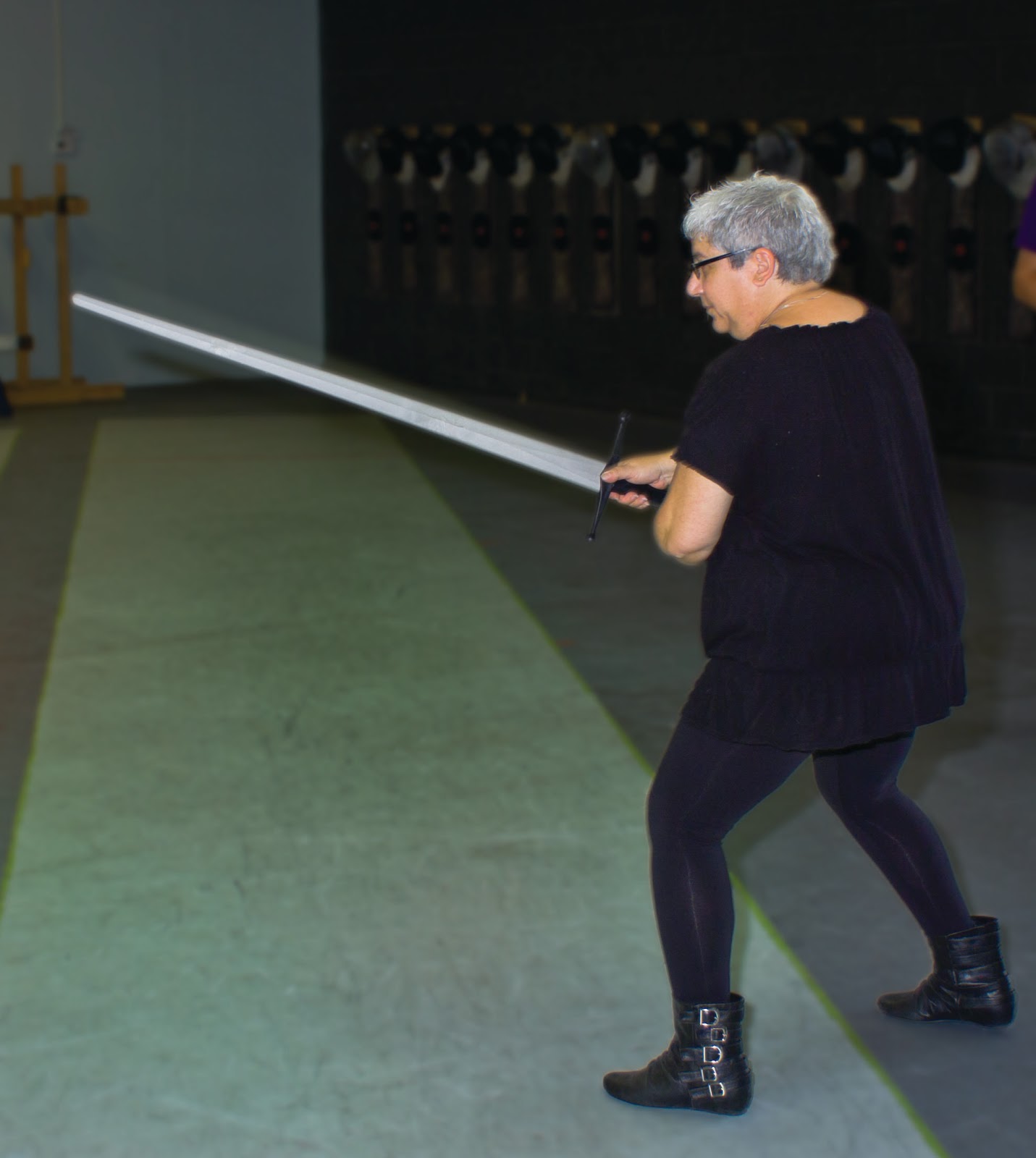
When it comes to research, I’m a hands-on kind of gal. So when I had an opportunity to put on some fourteenth century-style armor and get a sword fighting lesson, I was all over it.

I have worn armor before, and have even sat on a warhorse, a 2,000 pound Percheron while wearing light armor. My latest medieval mystery BLOOD LANCE features a lot of sword craft and jousting, and in order to give it the authenticity it needed, I’ve been venturing throughout southern California eliciting the help of chivalrous knights far and wide. And no one knows chivalry more than Scott Farrell. 


I met Scott Farrell some years ago when we did a podcast interview on his site Chivalry Today. But this hot August day, I met him in person, along with his wife April, and Scott’s fellow instructor Kyle Lazzarevich at Team Touche, a fencing club in San Diego, where they agreed to fit me with armor so I can get the feel of it.

Scott is an historical sword fighting coach and an author and historical interpreter on knights, medieval history, and chivalry.He got interested in the Middle Ages in high school and later got the re-enactor bug, and then started doing demonstrations for kids, which led him to think about connecting the code of chivalry into everyday life and to his podcasts. 


Medieval armor was crafted to fit the particular knight. You didn’t just buy it off the rack at ye olde Walmart. So Scott had to cheat a bit to fit it around my middle-aged frame and cheat some more to be able to position the helm where I could half-way see. All in all, it’s unwieldy as you can imagine, and heavy what with not being used to it and all. In reality, a full set of armor or full harness weighs anywhere between 60 and 100 pounds, but with the weight distributed all over the body it’s not as bad as it sounds. Knights had to be able to move, fight, mount the horse, dismount. Though because of the noise of mail and clanking plate, it wasn’t exactly build for stealth. As a matter of fact, I’m betting that it was pretty intimidating hearing that clanking sound approach and being confronted with a man in armor with a sword, mace, flail, war hammer, ax, pole axe…well. You get the picture.
It was wonderful just closing my eyes and feeling the weight of it, the smell, the sense of it on me, and imagining I am Crispin, my medieval protagonist and detective, who lost his knighthood years before these stories began.


Wearing armor is one thing—and a marvelous thing at that!—but what was it like to fight with a sword?

In college I took fencing and was pretty darned good at it. But fencing is a completely different style than medieval broad sword fighting. Fencing is about style. Though it was utilitarian there was more in the way of competition and style points than fighting and hacking away at an opponent. And though medieval broad swords were also used in competition in tournaments, the tournament was more for preparing for actual battle. Technique was important to keep you alive, but it was more about what worked rather than panache. After all, a broad sword is essentially a chopping and slashing weapon. It was your shield in defense as much as it was used as an offensive weapon.

I learned about medieval weapons through books and research. And I have my own cache of weapons I like to demonstrate when I make appearances at libraries and bookstores. But there is nothing like a hands-on approach. It’s not something that you can find readily just anywhere.

Scott gave me a lesson in some medieval long sword techniques. Keeping the blade edge toward your opponent and keeping it close to your body were good tips. The use of the thumb on the leading hand on the hilt can help balance but it is up to the student to decide to leave it vulnerable above the cross guard. When using the sword two-handed, the leading hand controls the vertical tilt of the sword, while the bottom hand controls the horizontal. Flashy Hollywood-style fighting might look good on the screen, but it leaves you wide open for a good gash to the torso. And who wants that?


After real training, could I take on an armored opponent? Well, let’s just say, I’d rather leave the swordplay to experts, like Crispin.


Jeri Westerson wanted to create her own brand of medieval mystery, and combined the concept of medieval mystery with hard-boiled detective fiction into what she calls “Medieval Noir.” Hard-boiled detective Crispin Guest, is a disgraced knight turned PI, solving crimes on the mean streets of fourteenth century London. The critically acclaimed series began with VEIL OF LIES, which garnered nominations from the Mystery Reader’s Journal Macavity Award for Best Historical Mystery and the Private Eye Writers of America Shamus Award for Best First PI Novel, the first medieval mystery to be so honored. Each of the next three novels in the series garnered award nominations and critical praise, as well.
 
Publisher’s Weekly said of the fifth in the series BLOOD LANCE; “Clever twists and convincing period detail make Westerson’s fifth 14th-century historical featuring disgraced knight Crispin Guest one of her best.” Kirkus Review said, “Guest’s fifth adventure again provides a lively tale of historical interest smoothly combined with a worthy mystery.”  The Richmond Times-Dispatch said, “Written with a keen knowledge of medieval history, ‘Blood Lance’ is another riveting tale of honor and heroism, grounded in period detail, a wealth of action and the continued development of her characters.” Jeri looks forward to the sixth, SHADOW OF THE ALCHEMIST in the fall of 2013.


Jeri has done talks around the country about the Middle Ages, demonstrating her cache of medieval weaponry. She has been a featured guest on the radio talk show Writers on Writing with host Barbara DeMarco-Barrett, and a guest lecturer at the Bowers Museum in Santa Ana. Jeri is vice president for the southern California chapter of Mystery Writers of America and is also vice president of the Los Angeles chapter of Sisters in Crime, and co-chair for the California Crime Writer’s Conference for June 2013. She is also a member of Private Eye Writers of America and the Historical Novel Society. Jeri is married to a commercial photographer, has a screenwriter son, and herds two cats, a tortoise, and the occasional tarantula at her home in southern California.

Visit Jeri’s blog www.Getting-Medieval.com for articles on history and mystery as well as author interviews. Or see what Crispin has to say on his very own blog. She is also part of the group blog Poe’s Deadly Daughters and you can follow her on Twitter and see what Crispin is up to on his Facebook page.