Showing posts with label Kaye George. Show all posts

Monday, March 23, 2020

An Interview with the Authors of the 2020 Agatha Short Story Nominees!

by Paula Gail Benson

Each year, it is such a delight for me to welcome the authors whose short stories have been nominated for the Agatha award, presented at Malice Domestic. This year, the event may have been postponed, but that's no reason not to celebrate the authors and their nominated stories! These authors are not only expert at the craft of short story writing, but also dear friends. Their nominated stories offer the depth and emotion that fine storytelling always evokes. Please take time to read each of the stories at the following links:

"Grist for the Mill" by Kaye George in A Murder of Crows (Darkhouse Books)
"Alex’s Choice" by Barb Goffman in Crime Travel (Wildside Press)
"The Blue Ribbon" by Cynthia Kuhn in Malice Domestic 14: Mystery Most Edible (Wildside Press)
"The Last Word" by Shawn Reilly Simmons, Malice Domestic 14: Mystery Most Edible (Wildside Press)
"Better Days" by Art Taylor in Ellery Queen Mystery Magazine

Welcome Kaye, Barb, Cynthia, Shawn, and Art to the Stiletto Gang!

How do you decide the point of view or who will tell your short story?

Kaye George
Kaye George:
The theme of the anthology was animal group names. You know, those odd ones, like a Murder of Crows (not coincidentally, the name of the anthology)? I looked up a bunch and discovered a Grist of Bees. I got the go-ahead to use that group and so my MC had to be a beekeeper.

Barb Goffman:
This is usually an organic issue for me. I don’t come up with a plot and then think about who would be the best person to tell the story. My stories are character driven, so once I know a character’s story—his/her situation that I want to tell—the point of view to use has already been decided. This was true of my Agatha-nominated story “Alex’s Choice.” That said, sometimes for a story to work, I need to tell it from multiple perspectives, so I do so. (You may be thinking, stories with multiple POV from Barb? I don’t recall those stories. That’s true. They haven’t been published—yet!)

Cynthia Kuhn
Cynthia Kuhn:
Seems to depend on the story—some require access to the protagonist’s perspective and some require more distance.

Shawn Reilly Simmons:
For me every story is different, but I do tend to focus on one POV of a character with a strong motivation to move the story forward. For this particular story, the character driving the story has a strong motivation to take inventory of his friendship with one of his oldest acquaintances.

Art Taylor:
I’ve used a variety of points of view across my stories—both in terms of prose point-of-view (I, you, he, she) and in terms of character (a detective’s perspective, a criminal’s, whoever’s). The narrator of “Better Days” is a journalist who was downsized from a major newspaper and has picked up a job at a small coastal North Carolina newspaper—in the same town where his father now lives, father and son both trying to build better relations in the years since the narrator’s mother died. That father-son relationship is core to the story, and it was important for me to show that relationship through the eyes of the son—both some of the frustrations about the relationship and also some redemption too. While the narrator sets out to investigate the crime here, the dad is the one who steps forward as the detective solving the case—not quite a Watson-Sherlock relationship, but certainly echoes of that, and there are many reasons that Watson is the narrator of the Sherlock stories, of course.

Each of your stories take place in a unique “universe” that becomes an important part of the plot. Which came first, your characters or the setting, or, if they were somehow melded, how?

Kaye George:
My characters were first, and the setting is just their homes and yards in Anywhere USA. I think people have backyard gardens and keep bees in a lot of places, so I didn’t specify where it is, exactly. I’d love for the reader to imagine this is their town.

Barb Goffman
Barb Goffman:
Combo for me. Sometime in the year before I wrote my story, I read a newspaper article about a tragedy involving a California family. They had been on the beach, and after their dog went into the ocean and didn’t come out, the father went in to save him. When he didn’t come out, another family member went in after him, and it went on and on until they all were gone—only the dog survived, eventually crawling out from the water. It was a horrendous occurrence, and I wished I could change things for those poor people. And then my beloved dog Scout died, and I wanted to bring him back. Both of these terrible events were the springboard for my story “Alex’s Choice,” which involves a couple who die in the ocean after their dog is swept away. Thanks to time travel, their child has the chance to go back and change what happened but is unexpectedly forced to make a choice that no one—let alone a child—should have to make.

Cynthia Kuhn:
For “The Blue Ribbon,” the setting came first—in fact, the moment that I read the description of the anthology project, the bakery and competition popped into my head. It doesn’t usually happen that vividly; typically I only get a wisp of an idea that has to be coaxed out of hiding.

Shawn Reilly Simmons
Shawn Reilly Simmons:
It was both in my case—for “The Last Word” I wanted the setting to be a high end restaurant in New York City, a location I can picture very well from my own experiences of living and working there, and a chef who is seasoned enough to have been through the ups and downs of a culinary career—praise, wealth, hunger, professional jealousy, failure. Maybe it’s because I wrote this story very quickly, but the setting and characters came to me simultaneously, I think!

Art Taylor


Art Taylor:
“Better Days” is the sequel to an earlier story that was also set on the North Carolina coast: “A Drowning at Snow’s Cut.” To that end, characters and setting both were already in place for the new story. But I will say that setting helped to determine to a great degree what happens here: a coastal town, a newcomer on a big yacht, the cocktail bar where this newcomer begins to move in on one of the local women, and then the narrator interested in the same woman—relatively new to the area himself and still trying to make peace with his life after having been laid off at the big-city newspaper. Character, plot, and place come together here in key ways.


If you had a spirit animal, what would it be?

Kaye George:
Some kind of beautiful bird. I’m afraid of heights and would love to be able to soar like they do. Maybe a hawk or an eagle.

Barb Goffman:
I had to look up what a spirit animal is. I’ll go with the badger, whose attributes apparently include focus on the task at hand, self-reliance, persistence, and strategy.

Cynthia Kuhn:
One psychic told me that my spirit animal was a butterfly; another said it was a giraffe. Still confused.

Shawn Reilly Simmons:
I had no idea so I just took an online quiz! The result: I’m a Turtle: The turtle totem wisdom teaches us about walking our path in peace and sticking to it with determination and serenity. Yeah, that sounds about right. While I do have a lot on my plate, I do keep a Zen attitude about it, and am always seeking balance in all things….I’ll take Turtle any day.

Art Taylor:
I took two quizzes to try to figure this one out. The first determined that my spirit animal was a whale, because I listen to inner voices and embrace my emotions. The second said that it should be a snake, because I’m “powerfully connected to life force and primal energy.” Also, my sign is Pisces, and my Myers-Briggs is INFJ. Somewhere in all that, that’s where you’ll find me.

What shoes will you (or if you prefer, would a character from your nominated short story) wear to the Agatha Banquet?

Kaye George:
Hmm, Kevin isn’t much for dressing up. He’ll probably wear leather tie shoes and slacks, though, after I stress to him that we are being honored there. If Vivian, the protagonist, shows up, she’ll wear low heels and a dress, I’m sure. These are not young, stylish people, see.

Barb Goffman:
I wear the same shoes every year. They are black. They are flat. They are comfortable.

Cynthia Kuhn:
Are flip flops allowed? If so, that would be my first choice.

Shawn Reilly Simmons:
Most likely something way more fancy with a higher heel than I normally wear, which is no shoes at all when I’m writing or doing yoga, or trainers when I’m running or lifting weights at the gym….yeah, I’ll have to acquire something more appropriate for an elegant event!

Art Taylor:
I’ve leaned toward more formal or more flashy in previous years—black wingtips, white bucks, this pair of hand-crafted blue-and-tan suede shoes from Portugal (no lie). But I’ve got a new pair of brown Clark’s—which my wife Tara says looks like every other shoe I wear on regular basis—and I think I’ll wear those. My character would appreciate too: down-to-earth, nothing flashy, just who he is.  

Thank you all for taking the time to be with us and answer questions. And, many thanks for all the wonderful stories you have written! During this time of social distancing, it’s grand to have terrific reading material!

AUTHOR BIOS:
Kaye George:
Kaye George is a national-bestselling, multiple-award-winning author of pre-history, traditional, and cozy mysteries (latest is Revenge Is Sweet from Lyrical Press). Her short stories have appeared online, in anthologies, magazines, her own collection, her own anthology, DAY OF THE DARK, and in A MURDER OF CROWS. She is a member of Sisters in Crime, Smoking Guns chapter, Guppies chapter, Authors Guild of TN, Knoxville Writers Group, Austin Mystery Writers, and lives in Knoxville, TN.

Barb Goffman:
Barb Goffman edits mysteries by day and writes them by night. She’s won the Agatha, Macavity, and Silver Falchion awards for her short stories, and she’s been a finalist for national crime-writing awards twenty-eight times, including thirteen times for the Agatha (a category record). Her work has appeared in many magazines and anthologies, including Ellery Queen’s Mystery Magazine, Alfred Hitchcock’s Mystery Magazine, Black Cat Mystery Magazine, and the 2019 anthology Crime Travel, which Barb also edited. To support her writing habit, Barb runs a freelance editing service, specializing in crime fiction. She lives with her dog in Virginia.

Cynthia Kuhn:
Cynthia Kuhn writes the Lila Maclean Academic Mysteries: The Semester of Our Discontent, The Art of Vanishing, The Spirit in Question, The Subject of Malice, and The Study of Secrets. Her work has also appeared in Mystery Most Edible, McSweeney’s Quarterly Concern, Literary Mama, Copper Nickel, Prick of the Spindle, Mama PhD, and other publications. Honors include an Agatha Award (best first novel), William F. Deeck-Malice Domestic Grant, and Lefty Award nominations (best humorous mystery). Originally from upstate New York, she lives in Colorado with her family. For more information, please visit cynthiakuhn.net.

Shawn Reilly Simmons:
Shawn Reilly Simmons is the author of The Red Carpet Catering Mysteries featuring Penelope Sutherland, an on-set movie caterer, and of several short stories appearing in a variety of anthologies including the Malice Domestic, Best New England Crime Stories, Bouchercon, and Crime Writers' Association series.

Shawn was born in Indiana, grew up in Florida, and began her professional career in New York City as a sales executive after graduating from the University of Maryland with a BA in English. Since then she has worked as a book store manager, fiction editor, mystery convention organizer, wine rep, and caterer. She serves on the Board of Malice Domestic and is co-editor at Level Best Books.

Shawn is a member of Sisters in Crime, Mystery Writers of America, the International Thriller Writers, and the Crime Writers’ Association in the U.K.

Art Taylor:
Art Taylor is the author of the story collection The Boy Detective & The Summer of ’74 and Other Tales of Suspense and of the novel in stories On the Road with Del & Louise, winner of the Agatha Award for Best First Novel. He won the 2019 Edgar Award for Best Short Story for "English 398: Fiction Workshop," originally published in Ellery Queen's Mystery Magazine, and his other awards have included the Agatha, the Anthony, the Derringer, and the Macavity.  He is an associate professor of English at George Mason University. 

Monday, August 21, 2017

B.K. "Bonnie" Stevens, True Friend and Good Writer

My first panel at Malice with Sally Goldenbaum, Liz Stauffer, Bonnie, me, and Wendy Tyson


by Paula Gail Benson


“It is not often that someone comes along who is a true friend and a good writer.”
― E.B. White, Charlotte's Web

When we learned last week about B.K. “Bonnie” Stevens passing, Shari Randall (writer, librarian, blogging partner, and friend) reminded me of E.B. White’s novel and his description of the barn spider Charlotte who, by weaving carefully chosen words into her web, saved Wilbur the pig’s life.

Bonnie embodied the phrase, “true friend and good writer.” Her life was a testament to the importance of constantly reaching out to others, eagerly opening your mind to learn, and joyously communicating.

Like Charlotte, Bonnie spoke truthfully, honestly, and with respect for the complexities of the world. She also understood the power and wonder of individuals sharing their lives with each other.

Chronologically, I did not know Bonnie for a long period of time, but our connection and friendship is enduring. I know that her inspiration, advice, and encouragement are part of my life forever.

Maybe one thing that drew us together, besides my great admiration for her prose, was our backgrounds in and appreciation of education. Bonnie spent a good portion of her life as an instructor and I came from a family of teachers. From that environment, you realize how delightful discovering new facts and information can be.

As I read Bonnie’s longer biography on her website, I realized that her philosophy of remaining open to whatever life brought her continued to enrich her own experience. Through her fiction and nonfiction, she passed that joy along to her readers.

While reading Bonnie’s stories or being able to discuss writing with her were incredible treats, experiencing her generosity of spirit was truly humbling. I once got up the nerve to ask if she would read one of my stories and give me feedback. She did so promptly with excellent suggestions, but also asked what others had told me about the story. All perspectives of the writing process were fascinating to her. Later, she asked me to read and react to a play she had written. I hesitated, wondering if my comments possibly could be of any help to her. After all, she had won an award for this play. She assured me that she wanted to hear from me because I wrote plays and directed them for a drama ministry, and my view, as someone who had staged a play, would give her valuable insight.

One of the kindest and most incredible gifts that Bonnie and her husband Dennis gave me was a phenomenal birthday celebration during Bouchercon in New Orleans. In advance, Bonnie sent me a list of possible venues, each sounding more wonderful than the last, and asked me to pick the location. She gathered good friends Art Taylor, Debra Goldstein, and Riley Miller to join us. By the end of the blissful evening, we had a table full of desserts (including the most delicious jalapeno lime cheesecake as well as an Almond Joy chocolate cake) and the great satisfaction of an unforgettable time spent in lovely conversation. [Please look for Art Taylor’s “Remembering Bonnie Stevens” message and other tributes by fellow bloggers on SleuthSayers.org and Debra Goldstein’s “In Memory of Bonnie (B.K.) Stevens” to be posted on Friday, August 25, 2017, here on The Stiletto Gang.]

Bonnie gave selflessly to so many. Just recently, I saw Kaye George’s remembrance of meeting Bonnie when she came to Kaye’s book signing at Malice Domestic. Kaye asked, “Are you the B.K. Stevens?” Bonnie said she was and asked Kaye, then President of the Guppies, the online chapter for Sisters in Crime, how she could join. From the time she became a member, Bonnie was constantly sending out words of welcome and congratulations.

When she began her blog “The First Two Pages,” Bonnie set out to highlight other writers’ work by allowing them to analyze the beginning of a short story or novel. Her initial post came from Kaye George and the latest messages are from the contributors to Kaye’s anthology to celebrate the solar eclipse, Day of the Dark (Wildside Press), some of whom are making their debut publication.

As I prepare to post these words on Monday, August 21, 2017, the day our country experiences the eclipse from coast to coast, I’m reminded of a special theatre tradition to recognize the passing of well known members of the Broadway community -- the simultaneous dimming of all the marquee lights for one minute at the 8:00 pm curtain hour. When the lights come back up, the shows go on.

While I experience this solar eclipse, I’ll remember Bonnie, my true friend and good writer, and think about all that she has done for the many lives she has touched. Thank you Dennis and daughters Sarah and Rachel for sharing her with us.
My New Orleans Bouchercon Birthday

Friday, July 14, 2017

Day of The Dark Anthology Debuts by Debra H. Goldstein


Day of the Dark Anthology Debuts by Debra H. Goldstein
Forty years is a long time.  In this case, on August 21, 2017, it will have been over forty years since a total solar eclipse passed over the continental United States. That’s why, according to news reports, people are booking hotels, signing up for excursions and making other plans to find a spot somewhere between Oregon and South Carolina to experience the eclipse. The location one chooses is important because it can mean the difference of having a second or up two minutes and thirty-eight seconds to view the moon pass between the sun and the earth.
Of course, when mystery writers think about the word eclipse, their excitement can become slightly skewed. Twenty-four authors proved that point in the anthology, Day of the Dark, which will be released by Wildside Press on July 21.

Edited by author Kaye George, who also has a story, The Darkest Hour, in the anthology, the stories roughly track the path across the United States that the shadow of the eclipse will take. A few occur on different continents and in timespans other than August 2017. The tales range from medium to dark, traditional to supernatural, but all meet the same standard of excellence.

Of course, I’m biased. One of my short stories, A Golden Eclipse, was accepted for the anthology. It reminds us that no matter what the event, there are always people ready to use any occasion to take advantage of others.

But don’t just read Day of the Dark for Kaye and my stories. There are twenty-two other authors included in the book.  These include Margaret S. Hamilton, Toni Goodyear, Kristin Kisska, Harriette Sackler, Joseph S. Walker, LD Masterson, Paul D. Marks, Katherine Tomlinson, Leslie Wheeler, Carol L. Wright, Christine Hammar, John Clark, Bridges DelPont, M.K. Waller, Laura Oles, Melissa Blaine, Cari Dubiel, Suzanne Berube Rorhus, Dee McKinney, Nupur Tustin, Cheri Vause, and KB Inglee.  Some are well known like Paul D. Marks, a 2013 Shammus winner and 2015 Anthony and Macavity nominee while, for others, like Nupur Tustin, this is their first published short story.

Not only are the authors diverse in their writing styles and story ideas, but they also proved their diversity when, after deciding that a portion of the proceeds Day of the Dark should be donated, they agreed that the causes to be supported will include Earth and Sky, Petconnect Rescue, Natural Resources Defense Council, Science Center in Finland, DonorsChoose.org, Friends of Goldendale Observatory, Friends of the Earth, Morehead Planetarium, Texas Museum of Science and Technology, DAPCEP.org for STEM education for future astronomers and scientists in Detroit, and personal friends in need. 

Whew! And so is the book.  I won’t be able to be anywhere to view the eclipse, but I’m okay with that.  I plan to be holed up with Day of the Dark. I’m certainly not waiting forty more years for this eclipse treat.

Monday, October 17, 2016

A Weekend in Atlanta Talking Short Stories

by Paula Gail Benson
Robert Mangeot, Fran Stewart, and PGB (Photo by Charlie Burton)

My membership in Sisters in Crime has afforded me many benefits, including information, encouragement, and camaraderie. I’m particularly grateful to have had the opportunity to participate in a recent short story workshop sponsored by the Atlanta Chapter and organized by its President Lisa Malice and Debra Goldstein. The event took place at the Decatur Public Library, a marvelous facility with well-equipped auditorium and a patio where those attending could have lunch and talk with the presenters. It was a true privilege for me to be on the program with three short story writers I greatly admire, Debra, Kaye George, and Robert Mangeot.


We set an ambitious goal to provide a comprehensive overview of the short story craft and submission process. While we concentrated on mysteries, we were delighted to have writers of literary fiction and other genres participating.

Debra Goldstein (Photo by Robert Mangeot)
Debra got us started with a description of the short story and an extremely effective analysis of how to develop conflict through phrasing and action. Robert brilliantly covered setting, character, and dialogue in a single segment that incorporated the use of Gone with the Wind to illustrate his points. Kaye and I took on the challenge of jointly teaching plotting strategies and discovered that our approaches and preferred structural models offered some interesting alternatives for putting together a story.

After lunch, Kaye explained how revision and editing were essential in developing a marketable manuscript. I followed up with some exercises to get the creative juices flowing. I’m pleased to report that the group left with almost everyone having written a six-word story a la Ernest Hemingway’s “For sale. Baby shoes. Never worn.” Robert finished up the day with a wonderful method for pursuing publication and left us all with the inspirational question: “What is your dream?” By telling us about his own writing journey and encouraging us to consider what we truly wished to achieve, he sent us forth excited about the possibilities.
PGB and Kaye George (Photo by Robert Mangeot)

Our participants were so enthusiastic, it became infectious. We exchanged a lot of very helpful information.

I am particularly grateful to Lisa Malice and her husband Lou for their generous hospitality. Kaye and I were fortunate enough to stay with them for the weekend. Not only did we get to enjoy Lisa and Lou’s lovely home, fabulous food, and great conversations, but also we had a terrific time practicing our presentation and catching up.


Thank you to the Atlanta Chapter for taking the time to focus on the short story. I appreciate my fellow presenters so very much. I always learn from each of you and I value our friendships. Finally, many thanks to all those who attended. May you find the success in writing that you are seeking!

Monday, March 21, 2016

Writing Multiple Series: featuring Kaye George/Janet Cantrell


This is my third interview with an author of multiple mystery series. My guest is Kaye George who is also known as Janet Cantrell. As Kaye, she writes about Imogene Duckworthy, Cressa Carraway, and the (Neanderthal) People of the Wind. As Janet, she pens the Fat Cat cozies. Distinguished for her short stories as well as her mystery novels, Kay has been nominated for an Agatha in two categories (Best First Novel and Best Historical Novel) and served as the President of the Guppy Chapter of Sisters in Crime. Welcome, Kaye/Janet!


How did you initially decide to write fiction?

It wasn’t a decision. It’s something I’ve been doing my whole life. I made up stories to go with my crayon drawings before I could write words. In grade school I drew little comic strips and sixth grade wrote two “novels”. I think they were about five pages each. In high school and college, I sent short stories to magazines. I wrote short stories for creative writing classes in college. I’ve never not written fiction.

You have published short stories. How did those help and continue to influence your career?

The first things I got published were short stories. This was after I gave up on sending them to Atlantic and The New Yorker, as I’d done for years. I decided to concentrate on novels, thinking I had a better chance of getting them published. I initially wrote literary fiction, but soon decided I should write what I most enjoyed reading, and that was mystery. During the ten years it took to get a mystery novel published, online short story markets started opening up and I started submitting. I’m still doing that, along with the novels.

Who publishes each of your series and how did you begin writing each series?

I’m self-publishing the Imogene Duckworthy humorous Texas mysteries. The first in that series was the first mystery novel I got published, but I parted with my publisher after a year. That book won an Agatha nomination, which my publisher refused to acknowledge. That didn’t sit well with me! After I republished the first one, CHOKE, I self-published SMOKE and BROKE pretty quickly. STROKE is in the works.

The first mystery novel I completed and queried (for about 10 years) is now called EINE KLEINE MURDER, published by Barking Rain Press. In frustration over my many, many rejections, I turned to writing the over-the-top Duckworthy series and got that published first. But I kept coming back to my first love (not my first completed mystery novel, but the first that I thought had a chance). The main character, Cressa Carraway, is the successful professional musician I never was. I’ve always been an amateur, except for some string quartet work that paid pretty well. I’m glad I persisted and got it out there. It was a Silver Falchion finalist. The second in that series, REQUIEM IN RED, will come out with the same publisher in April.

I got interested in reading very old historical fiction, Roman, Greek, ancient Egyptian, and decided I wanted to take fiction as far back as I possibly could. This was when the Neanderthal DNA was being analyzed and more and more interest and discoveries centered upon them. The more I learned, the more I wanted to write about them. DEATH IN THE TIME OF ICE was the most difficult project I’ve ever done. I ended up using a somewhat alternative historical setting, putting Neanderthals in North America. That’s because I also got hooked by the mega-fauna (really, really big animals!) that roamed this continent at the same time the Neanderthals were a distinctive people. I got rave rejections for this from some good agents, who told me they loved my book (!), but didn’t know how to sell it. One night I was complaining on Facebook that I had gotten yet another of those rejections and Jay Hartman, from Untreed Reads, who had published some of my short fiction, asked to see it. And published it! That book was nominated for Best Historical Agatha Award. The second in that series, which I’m calling People of the Wind, is DEATH ON THE TREK and will be out in June.

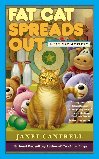
Meanwhile, because I didn’t have enough to do, I guess, I was hankering after a cozy series. I kept submitting proposals to BookEnds Literary, an agency that places many cozy mysteries, and kept getting them rejected. A proposal, I had learned from some experienced cozy writers, is a detailed synopsis of the first book, the first three chapters, and sketches for two more in the series. With each of those rejections, it was like the characters I had created and lived with for at least a month, died. I got wind of a series I thought I could do, based in Texas where I lived, and wanted to audition for it, but couldn’t write yet another proposal and get it rejected. A friend suggested I send in CHOKE instead and inquire about the series. I did, Kim Lionetti liked my voice, and suddenly, I was agented! I didn’t get that proposal, but she got me the Fat Cat series. The first two are out, FAT CAT AT LARGE and FAT CAT SPREADS OUT. The third, FAT CAT TAKES THE CAKE, will come out in April. I write that series under the name Janet Cantrell.

Did you notice that I have TWO books coming out in April? Yikes!

How many books do you write in a year and what is your publication schedule?

I’d like to write one a year, but have been doing more. The Fat Cat publisher, Berkley Prime Crime, wanted a book every nine months, so everything else went on hold while I did those three books. As a result, the second Neanderthal book is coming out a couple of years after the first one. The second Cressa Carraway was nearly finished a few years ago, so it wasn’t too hard to get it in shape.

Do you write under more than one name? If so, was that by your choice or a publisher’s request?

I write mostly as Kaye George. The Fat Cat series is written as Janet Cantrell because the publisher owns all the rights to that series. The initial concept was theirs and they own the series, the characters, and the author name.

What “relationship” do you have as author with each of your series’ protagonists?

I love all of them! They are all my children, my creation, born out of labor and love.

Setting has an important role in each series you write. What is your approach to developing a setting that fuels the story and draws in readers?

I use west Texas, where I was living when I started writing the Duckworthy series because I found much to be darkly humorous about. It’s a harsh place with wonderful people.

I set the Cressa Carraway books in the Midwest, where I’m from. It seems natural to set them there.

It was requested I set Fat Cat in Minneapolis, where I’ve also lived. So that wasn’t difficult.

It was very difficult to draw the setting for the Neanderthals. They lived before the last Ice Age, when there was no Mississippi River. I had to do tons of research just to describe the setting. It was all fun, though.

Is it a challenge to keep coming up with original and inventive plots? How do you do it?

No, the challenge is to find time to write everything that’s in my head. I had lots more ideas than I’ll ever live long enough to write.

Since at The Stilletto Gang we like to delve into shoes and accessories, what are your protagonists’ favorite foot or carrying apparel? (Pictures are welcome!)

This is the hardest question! I love shoe shopping, but my feet are hard to fit and I don’t often find shoes I can buy. I guess that, as a consequence, my characters don’t have too much interest in shoes.

Immy Duckworthy wears sneakers and cowgirl boots. Cressa Carraway probably mostly wears sneakers. Well, Chase Oliver, the Fat Cat’s owner, does, too. (The Fat Cat is named Quincy.) I guess I’m in a shoe rut! Enga Dancing Flower wraps her feet in skins and ties them with leather thongs when it’s cold, but she’s barefoot a lot of the time.


Kaye George/Janet Cantrell

Kaye George, national-bestselling and multiple-award-winning author, writes several mystery series: Imogene Duckworthy, Cressa Carraway (Barking Rain Press), People of the Wind (Untreed Reads), and, as Janet Cantrell, Fat Cat (Berkley Prime Crime cozies). The third, Fat Cat Takes the Cake, will appear April 2016. The second Cressa Carraway novel, Requiem in Red, will appear in early 2016. The second People of the Wind, Death on the Trek, comes out in June 2016. Her short stories appear in anthologies, magazines, and her own collection, A Patchwork of Stories. She reviews for Suspense Magazine. She lives in Knoxville, TN. http://kayegeorge.com/